Calculate your HSA tax savings
Counts toward the same limit.
Started mid-year? Check your prorated HSA limit
Open calculatorThe growth figure assumes you contribute the same amount at the end of each year and never withdraw it, at a steady return. Real returns vary, and most people spend some of their HSA on care along the way. Treat it as a picture of what the account can do, not a forecast.
A health savings account is the only account in the tax code that's tax-free going in, while it grows and coming out for medical costs. Contributions through payroll also skip the 7.65% FICA tax. At a 22% federal bracket and 5% state tax, putting the 2027 self-only maximum of $4,500 in an HSA saves about $1,560 in taxes, and investing it every year for 20 years at 6% could build more than $165,000. Enter your numbers to see your savings.
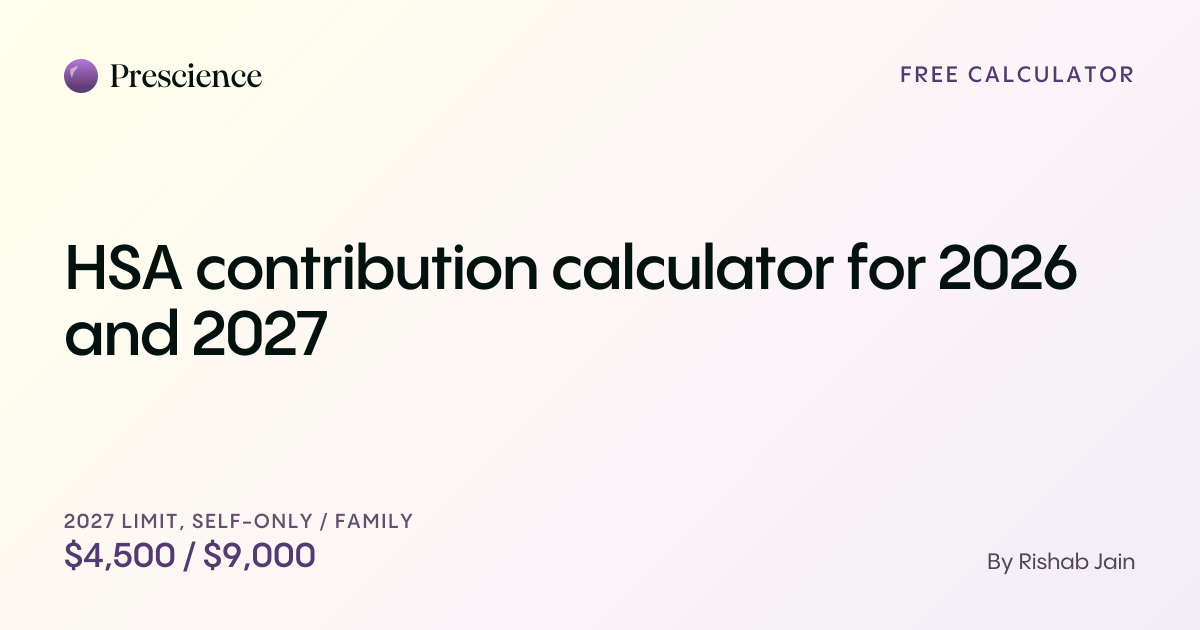
- 2027 limit, self-only / family
- $4,500 / $9,000
- 2026 limit, self-only / family
- $4,400 / $8,750
- Taxes avoided through payroll
- Federal, most state, FICA
- States that tax HSA contributions
- California and New Jersey
The triple tax advantage
- Going in: contributions reduce your taxable income. Through payroll, they also skip Social Security and Medicare tax, which a 401(k) doesn't.
- While it grows: interest, dividends and investment gains aren't taxed each year.
- Coming out: withdrawals for qualified medical expenses are tax-free at any age, including expenses from years ago if you've kept the receipts and had the HSA then.
After 65, you can withdraw HSA money for anything; non-medical withdrawals are taxed as income, like a traditional IRA, but with no penalty. Before 65, non-medical withdrawals are taxed and pay a 20% penalty.
Worked examples
Who can contribute
You need to be covered by an HSA-qualified high-deductible health plan and have no other disqualifying coverage: no general-purpose FSA, no Medicare and no non-HDHP plan through a spouse. You also can't be claimed as someone else's dependent. Starting in 2026, bronze and catastrophic marketplace plans also count as HSA-qualified.
| 2026 | 2027 | |
|---|---|---|
| Minimum deductible, self-only / family | $1,700 / $3,400 | $1,750 / $3,500 |
| Maximum out-of-pocket, self-only / family | $8,500 / $17,000 | $8,700 / $17,400 |
| HSA limit, self-only / family | $4,400 / $8,750 | $4,500 / $9,000 |
| Catch-up, age 55+ | $1,000 | $1,000 |
Employer contributions count toward the same limit. If you start mid-year, your limit is usually prorated by month; the HSA contribution calculator works out the exact figure and the amount per paycheck. For the full rules, see HSA eligibility rules.
Getting the most out of an HSA
- Contribute through payroll, not directly Direct contributions are deductible on your return but don't get the 7.65% FICA savings.
- Capture any employer match first Employer HSA money is free and also skips payroll tax.
- Keep a cash cushion for the deductible Leave enough in cash to cover your deductible. Invest the rest.
- Invest for the long term Most HSA providers let you invest above a minimum balance in low-cost funds, the same way you would in a 401(k).
- Save your receipts You can reimburse yourself for qualified expenses years later, as long as they happened after you opened the HSA.
Whether an HSA plan is right for you in the first place depends on your expected care. The HDHP vs PPO calculator compares the two with your numbers.
HSA or 401(k) first?
If you have both, a common order is: contribute enough to your 401(k) to get the full employer match, then fund the HSA to its limit, then go back to the 401(k). The HSA comes before extra 401(k) money because it avoids FICA tax on payroll contributions and can come out tax-free for medical costs, while 401(k) withdrawals are taxed.
| HSA | Traditional 401(k) | |
|---|---|---|
| Contributions | Pre-tax, and no FICA through payroll | Pre-tax, but FICA still applies |
| Growth | Tax-free | Tax-deferred |
| Withdrawals for medical costs | Tax-free at any age | Taxed, plus a 10% penalty before 59½ |
| Other withdrawals after 65 | Taxed as income, no penalty | Taxed as income |
| Required minimum distributions | None | Yes, starting at 73 or 75 |
| 2026 limit | $4,400 / $8,750 | $24,500 |
HSAs and Medicare
Once you enroll in any part of Medicare, you can't contribute to an HSA, though you can keep spending what's in it. Medicare Part A coverage can start up to six months before the month you sign up, so people who delay Medicare past 65 and then enroll should stop HSA contributions six months before enrolling to avoid an excess contribution.
In retirement, HSA money can pay Medicare Part B and Part D premiums, Medicare Advantage premiums and out-of-pocket costs tax-free. It can't pay Medigap premiums. Our guide to employer health insurance and Medicare covers the rules for employees over 65.
Mistakes that cost HSA owners money
- Contributing over the limit. Excess contributions are taxed 6% a year until you withdraw them. Remember that employer contributions count.
- Leaving everything in cash. A balance that never gets invested misses most of the long-term benefit.
- Contributing directly instead of through payroll, which gives up the 7.65% FICA savings.
- Losing eligibility mid-year without adjusting, for example by joining a spouse's non-HDHP plan or Medicare.
- Using the money for non-medical costs before 65. The withdrawal is taxed as income and pays a 20% penalty, which wipes out years of tax savings.
- Not naming a beneficiary. A spouse who inherits an HSA can keep it as their own; anyone else pays income tax on the balance.
Paying yourself back later
There's no deadline for reimbursing yourself from an HSA. If you pay a $1,200 bill out of pocket this year and keep the receipt, you can withdraw $1,200 tax-free in ten years, after the money has had a decade to grow. The only conditions are that the expense happened after you opened the HSA and that you didn't already claim it as a deduction or get it reimbursed some other way.
That's why some people treat an HSA as a retirement account: they pay current medical costs from their checking account, invest the full HSA, and save receipts in a folder or app. It only works if you can afford the bills now, so keep enough cash for at least your deductible before trying it. Save itemized receipts and explanations of benefits, not card slips, since you may need to show the IRS what each withdrawal paid for. A shared folder or the HSA provider's own receipt vault both work, as long as it will still be there in twenty years.
For employers: HSAs as a benefit
Employer HSA contributions are deductible for the company, tax-free to employees and free of payroll tax on both sides. Even $500 a year makes an HDHP feel much less risky for employees. Our guide to employer HSA contributions covers how much companies typically give and the comparability rules.