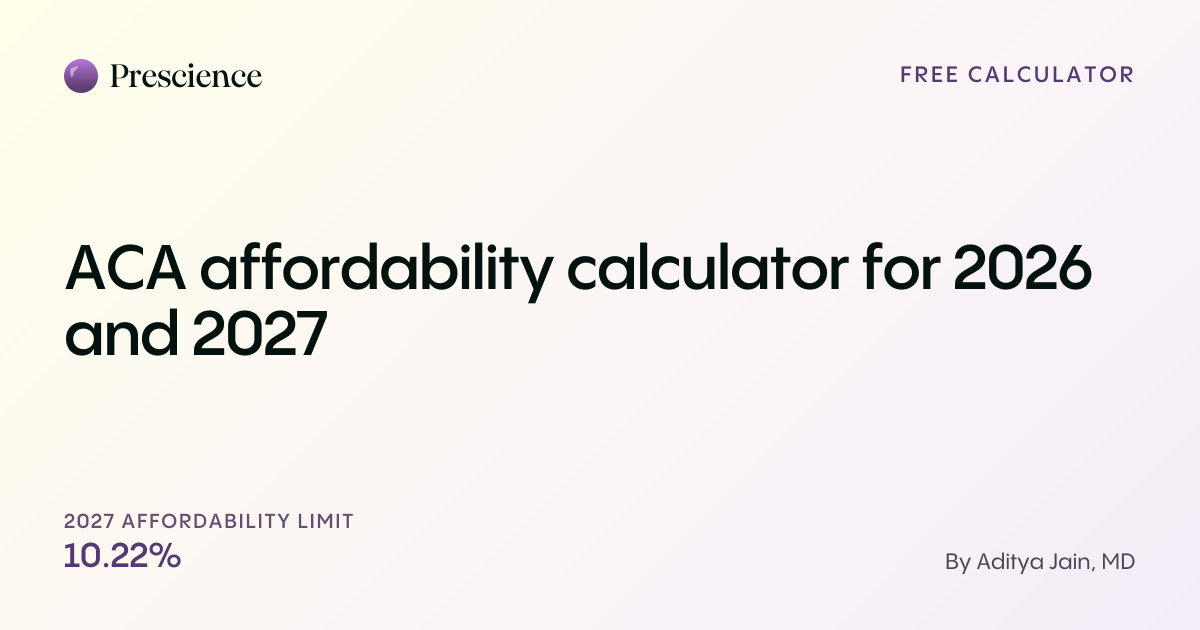
Check your contribution
For the cheapest self-only plan you offer that meets minimum value.
The calculator runs in your browser and doesn't send what you enter anywhere. Test the lowest-paid employee in each class: if the cheapest plan is affordable for them, it's affordable for everyone paid more under the same safe harbor.
The three safe harbors
| Safe harbor | How it works | 2026 | 2027 |
|---|---|---|---|
| Federal poverty line | The single-person poverty line times the limit, divided by 12. One number for every employee. | $129.89 | $135.92 |
| Rate of pay, hourly | The hourly rate times 130 hours times the limit. | $258.96 at $20/hour | $265.72 at $20/hour |
| Rate of pay, salaried | Monthly salary times the limit. | $498 at $60,000 | $511 at $60,000 |
| W-2 wages | Box 1 wages times the limit, checked after the year ends. | $498 at $60,000 | $511 at $60,000 |
- Federal poverty line is the simplest and safest: price the cheapest plan at or below it and you're done. It uses the poverty line in effect six months before the plan year, so 2026 plans use the 2025 line and 2027 plans the 2026 line. Alaska ($169.90 in 2027) and Hawaii ($156.36) have higher lines.
- Rate of pay works when you know each employee's hourly rate or salary up front. Use the lowest rate during the year for hourly staff.
- W-2 is the riskiest: Box 1 excludes pre-tax contributions such as 401(k) deferrals and Section 125 premiums, and you only know the final number after the year ends.
- Amounts here are rounded down to the cent, so a contribution at or below them passes.
Who has to pass the test
Only applicable large employers (50 or more full-time employees including equivalents) face the employer mandate. If a full-time employee's offer is unaffordable and they get a marketplace premium tax credit instead, the employer owes $5,010 a year for that employee in 2026 and $5,670 in 2027. The total can't exceed the penalty for offering no coverage at all: $3,780 per full-time employee after the first 30 in 2027.
Affordability is tested on self-only coverage only. Family coverage can cost more without failing the test, though since 2023 family members can qualify for marketplace subsidies when their own cost passes the limit.
Making coverage affordable without raising your cost
The cheapest way to pass affordability is a plan that costs less to begin with. At Prescience we price plans for small teams so employers can cover more of the premium for the same budget.
At Prescience, we design and run your company's health plan, from setup and enrollment to claims, compliance and COBRA. What your team gets:
- An effective $0 deductible, so the plan helps from the first visit.
- Simple copays shown before a visit, capped by a low out-of-pocket maximum.
- A broad national PPO network, plus providers we contract with directly.
- 24/7 physician-led care navigation: a care team that finds the right provider, books appointments and explains costs up front.
What your company gets: one monthly cost set in your quote, usually 10–20% below comparable fully insured coverage and fixed before the plan starts, with no admin fees. You keep your payroll provider, and the plan can start mid-year.
See what your team would pay with Prescience
Answer a few questions about your team and get a quote in about 60 seconds, or talk it through with one of our benefits experts.