Work out your HSA limit
Count months you were eligible on the 1st.
These count toward the same limit.
What you've already put in this year, at any job.
26 for a full year paid every two weeks; fewer if you're starting mid-year.
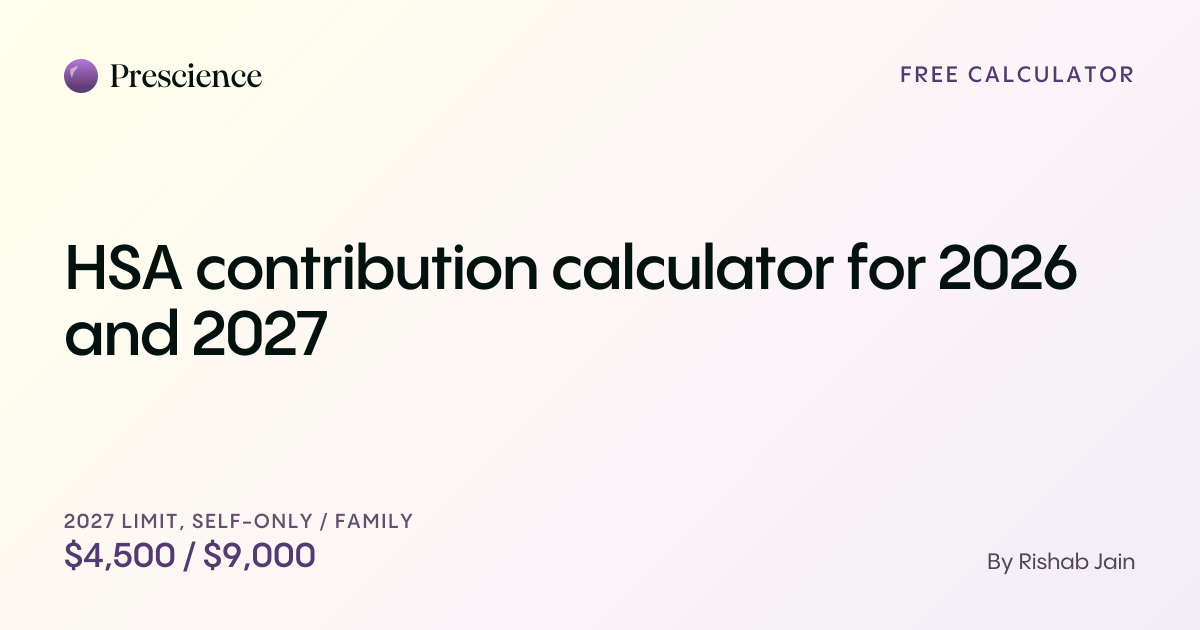
"HSA contribution" shows up in our Search Console data more than almost any other benefits term, usually from people trying to figure out how much to set aside per paycheck. The calculator answers exactly that: your limit for the year, minus what your employer puts in, divided across your remaining pay periods.
HSA and HDHP limits for 2026 and 2027
| 2026 | 2027 | |
|---|---|---|
| HSA limit, self-only | $4,400 | $4,500 |
| HSA limit, family | $8,750 | $9,000 |
| Catch-up contribution (55+) | $1,000 | $1,000 |
| HDHP minimum deductible, self-only | $1,700 | $1,750 |
| HDHP minimum deductible, family | $3,400 | $3,500 |
| HDHP out-of-pocket maximum, self-only | $8,500 | $8,700 |
| HDHP out-of-pocket maximum, family | $17,000 | $17,400 |
Limits apply per calendar year, regardless of your plan year. You have until the tax filing deadline (normally April 15) to make contributions for the prior year, so 2026 contributions can still be made in early 2027.
What counts toward the limit
- Your payroll contributions, pre-tax through a Section 125 plan.
- Employer contributions, including any "seed" money or wellness rewards deposited to your HSA.
- Contributions you make directly to your HSA provider, which you deduct on your tax return.
- Not rollovers. Moving money from another HSA doesn't count, and neither do investment gains.
If you and a spouse both have HSAs and either has family HDHP coverage, you share one family limit, split however you like. Each spouse who is 55 or older adds their own $1,000 catch-up, but only to their own HSA.
Partial years and the last-month rule
You're HSA-eligible for a month only if you're covered by an HDHP on the first day of that month and have no disqualifying coverage, such as a general-purpose health FSA, Medicare or a non-HDHP plan. Normally your limit is prorated: one-twelfth for each eligible month.
The last-month rule is the exception. If you're eligible on December 1, you can contribute the full year's limit. The catch is the testing period: you must stay eligible through December 31 of the following year. If you don't, the extra you contributed becomes taxable income plus a 10% additional tax.
If you contribute too much
Excess contributions are subject to a 6% excise tax for every year they stay in the account. Ask your HSA provider for a "return of excess contribution" before your tax filing deadline; you'll pay income tax on any earnings it made, but not the 6%.
Read more about how HSAs work in our HSA guide, and what you can spend the money on in HSA and HRA eligible expenses.
What an HSA contribution is worth in taxes
An HSA is the only account in the tax code that is tax-free on the way in, while invested and on the way out for qualified medical expenses. Contributions through payroll also skip Social Security and Medicare taxes, which a deduction on your tax return does not.
If you contribute directly instead of through payroll, you still get the income tax deduction on Form 8889 but not the 7.65% payroll tax saving. That's why payroll is usually the better route when your employer offers it.
- Spend or save. Money spent on qualified medical costs comes out tax-free at any age. Money left in the account rolls over every year and can be invested.
- After 65, you can withdraw for any purpose without penalty; non-medical withdrawals are taxed as income, like a traditional IRA.
- Before 65, non-medical withdrawals are taxed plus a 20% penalty.
- Keep receipts. You can reimburse yourself years later for a medical expense incurred after you opened the HSA, as long as you can document it.
One more reason people search for HSA rules this year: starting in 2026, the One Big Beautiful Bill Act made bronze and catastrophic exchange plans HSA-compatible and let direct primary care arrangements sit alongside an HSA, within limits. If you buy your own coverage, check whether your plan now qualifies.
For employers: contributing to employee HSAs
If your company offers an HSA-qualified plan, an employer contribution is one of the most tax-efficient benefits you can give. Employer deposits aren't wages: no income tax for the employee and no payroll tax for either side. A $1,000 deposit costs the company $1,000, while an equal raise would cost $1,076.50 after the employer's payroll tax and be worth less to the employee after tax.
- Comparability rules. Contributions made outside a cafeteria plan must be comparable for all employees with the same coverage tier, or a 35% excise tax applies. Contributions through a Section 125 plan follow cafeteria plan nondiscrimination rules instead.
- Deposit timing. Many employers spread contributions across paychecks; others deposit a lump sum in January. A lump sum is more generous but can't be recovered if the employee leaves.
- Count it in the limit. Tell employees what you'll deposit so they can lower their own contributions and avoid excess contributions.
- It's their money. HSA balances belong to the employee immediately and go with them when they leave.
Most employers I talk to contribute somewhere between $500 and $1,500 a year for single coverage, often to offset part of the deductible. If you're weighing an HSA plan against a copay plan for your team, our HDHP vs. copay plan guide compares the total cost for typical employees.
A year-end HSA checklist
- Add up every contribution Your payroll contributions, your employer's deposits and anything you sent directly, for every job you had this year.
- Confirm your eligible months Count each month you had HDHP coverage on the first day and no disqualifying coverage, including a spouse's general-purpose FSA that could pay your claims.
- Top up before the deadline If you're under your limit, you can still contribute for this year until your tax filing deadline in April. Tell your HSA provider which year the deposit is for.
- Remove any excess If you're over, request a return of excess contribution before the deadline to avoid the 6% excise tax.
- File Form 8889 Report contributions and distributions with your tax return. Your HSA provider sends Form 5498-SA and 1099-SA with the numbers you need.
When an HSA isn't the best deal
HSAs are great tax shelters, but they only exist because the plan underneath has a high deductible. A lot of the people we talk to are putting money in an HSA mainly to cover a deductible they'd rather not have.
See what your team would pay with Prescience
Answer a few questions about your team and get a quote in about 60 seconds, or talk it through with one of our benefits experts.