Side by side
| HDHP | Copay plan | |
|---|---|---|
| Monthly premium | May be lower; compare actual quotes | May be higher; compare actual quotes |
| Average single premium at employers, 2025 (KFF) | $8,620 a year ($718/month) | PPO average: $9,818 a year ($818/month) |
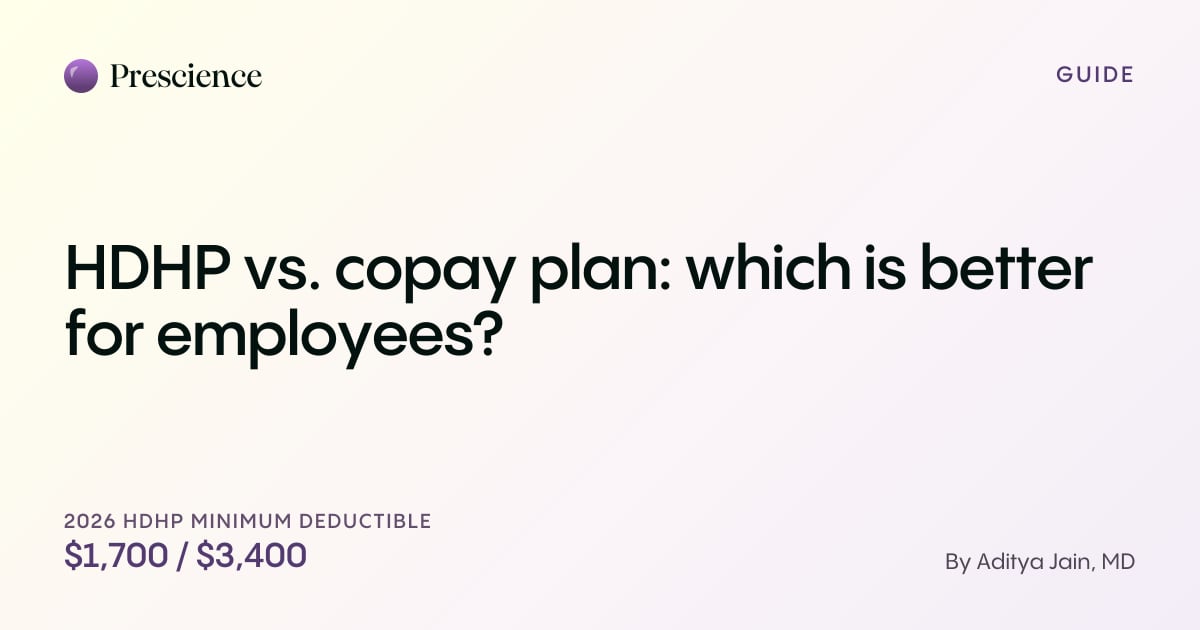
| Deductible | At least $1,700 / $3,400 in 2026 | Often lower, sometimes none for visits |
| Average single deductible, 2025 (KFF) | $2,609 | PPO average: $1,337 |
| Office visit | Usually negotiated price before deductible; permitted exceptions apply | Flat copay (KFF average: $27 primary care, $45 specialist) |
| Preventive care | Covered before the deductible | Covered before the deductible |
| Out-of-pocket maximum, 2026 legal ceiling | $8,500 / $17,000 | $10,600 / $21,200 |
| Conventional HDHP / ACA ceiling, 2026 | Yes | No |
| HSA contributions | Only if plan and individual eligibility rules are met | Generally unavailable for conventional first-dollar medical coverage; statutory exceptions apply |
"Copay plan" here means a plan where most common services have a flat copay and the deductible is low or doesn't apply to visits. Many PPOs work this way; HMOs can too. An HDHP can sit on any network, so the comparison is about cost sharing, not doctors. See HMO vs. PPO vs. EPO for networks.
KFF's HDHP/SO and PPO categories describe survey groups, not otherwise identical competing quotes. A PPO can also use an HSA-qualified design. The difference between the survey averages therefore cannot establish your employer's savings or the best plan for any particular employee.
The 2026 HDHP and HSA rules
| Self-only | Family | |
|---|---|---|
| Minimum HDHP deductible | $1,700 | $3,400 |
| Maximum HDHP out-of-pocket | $8,500 | $17,000 |
| HSA contribution limit (employer + employee) | $4,400 | $8,750 |
| Extra catch-up contribution, age 55+ | $1,000 | $1,000 |
- Telehealth before the deductible is now permanently allowed without losing HSA eligibility, for plan years starting in 2025 or later.
- Individual-market bronze and catastrophic coverage: qualifying coverage is treated as HSA-compatible from 2026 under IRS Notice 2026-5, including specified off-Exchange situations. The change does not automatically qualify every employer bronze plan.
- Direct primary care: qualifying arrangements can preserve HSA contribution eligibility in 2026 when aggregate monthly fees stay within $150 for one person or $300 for more than one. Eligible fees may be paid from an HSA; service and payment restrictions apply.
- Preventive care, including many screenings and some chronic-condition medicines on the IRS list, can be covered before the deductible.
Four years in one employee's life, on each plan
These are fictional plan designs, not actual quotes. The company pays the entire premium in both cases. A $100 monthly premium difference saves $1,200 per employee annually; after a $1,000 employer HSA deposit, its saving is $200, before fees. Assume a full upfront HSA deposit and full-year eligibility.
- HDHP: $718 a month, $2,000 deductible, then 20% coinsurance, $5,000 out-of-pocket maximum, $1,000 employer HSA deposit.
- Copay plan: $818 a month, $30 primary care, $40 therapy and $10 generic drug copays, $350 ER copay, $500 deductible then 20% for imaging and hospital care, $4,000 out-of-pocket maximum. Physical therapy is $40 per visit. The ER copay replaces all other cost sharing for the illustrated ER claim.
| Year | HDHP | Copay plan | Better for the employee |
|---|---|---|---|
| Healthy: a physical, 2 sick visits ($150 each), a generic prescription ($15/month) | $480 paid from the HSA; $520 left over | $180 ($60 visits + $120 drug copays) | HDHP has $700 more combined cash/account value; it is not $700 less in claim payments |
| One ER visit (allowed amount $2,500) | $2,100, or $1,100 after the HSA deposit | $350 | Copay plan, by $750 |
| Knee MRI ($3,000) + 10 physical therapy visits ($120 each) | $2,440, or $1,440 after the HSA deposit | $1,400 ($1,000 MRI + $400 PT) | About even |
| High-cost covered episode ($20,416 assumed allowed claims) | $5,000 maximum, or $4,000 after the HSA deposit | $4,000 maximum | Even |
The table separates a quiet year, moderate bills and a high-cost year. It is a decision aid, not a general rule that one design always wins in each category. I would also calculate annual employee premiums plus the applicable maximum, less employer account contributions, for covered in-network care. Exclusions and out-of-network bills remain additional exposure.
What the HSA is really worth
Under federal rules, eligible HSA contributions receive favorable income-tax treatment, earnings can grow tax-free, and withdrawals for qualified medical expenses can be tax-free. Contributions through a Section 125 cafeteria plan can also avoid payroll tax. State treatment can differ. Unused balances carry over and remain the employee's after leaving the company.
Who each plan suits
- Consider an HDHP: when actual premium savings and employer HSA deposits compensate for cost sharing, and the employee can handle the early-year bill.
- Consider a copay plan: when its actual benefits make recurring services affordable and its premium is sustainable. Compare medicines, therapy and specialist costs individually.
- Either, after comparing employer funding: an employer HSA deposit can reduce the cash an employee needs to supply, but does not change the insurance deductible. KFF found that 3% of workers with single coverage in HSA-qualified HDHPs received an employer contribution at least as large as their deductible. Check deposit timing as well as the annual amount.
The problem is that employers can't pick plans person by person, and people don't know in January whether they'll need surgery in June. Offering both side by side is common; see offering two health plans.
Two ways to close the deductible gap
Employers who like the HDHP's lower premium but not its effect on sick employees can fund part of the deductible. There are two tools, and they behave differently.
| Employer HSA deposit | HRA paired with the plan | |
|---|---|---|
| When the company pays | On the contribution schedule, regardless of claims | Only when an employee has a bill |
| Who owns the money | The employee, permanently | The company; unused money stays with it |
| Keeps HSA eligibility | Yes | Only if the HRA is limited (for example, post-deductible or dental and vision) |
| Average 2025 employer contribution (KFF) | $690 single | $1,966 single |
| Best for | Recruiting, long-tenure teams, people who save | Keeping cost low while protecting the employees who get sick |
HSA traps employees and employers hit
- Medicare. Once an employee enrolls in any part of Medicare, including Part A, they can't contribute to an HSA. See employer health insurance and Medicare.
- A spouse's health FSA. If a spouse has a general-purpose health FSA that can pay the employee's bills, the employee isn't HSA-eligible. A limited-purpose (dental and vision) FSA is fine.
- Other coverage. Being covered by a non-HDHP plan, such as a spouse's copay plan, also ends eligibility.
- Mid-year enrollment. Contribution limits are prorated by month unless the employee uses the last-month rule, which requires staying HSA-eligible for the next full year.
- Family deductibles. Conventional HSA-qualified family coverage generally cannot pay non-exempt benefits before the $3,400 family minimum in 2026. Individual-market bronze and catastrophic exceptions should be checked separately.
- Employer deposits must be comparable. Outside a Section 125 plan, employer HSA contributions must be the same amount or percentage for comparable employees.
How to decide for your team
- Look at who you employ Ask for anonymous benefit priorities and affordability concerns. Have employees review personal medical scenarios privately with the administrator. Do not ask managers to collect diagnoses or pregnancy plans.
- Price both on the same census Get an HDHP and a copay plan quote on the same network. Note the monthly difference per employee and per family.
- Decide what you'll give back Choose an HSA deposit or HRA amount. Model several deposit amounts against covered claims and available cash. Even funding the full deductible does not change the plan’s coinsurance, network or maximum.
- Run the four scenarios Use the healthy year, ER visit, MRI and baby above with your quoted numbers. Share the table with employees during open enrollment so they can choose with real figures.
- Consider offering both If your carrier allows it, offer both plans and let employees choose. Set your contribution so the HDHP's lower premium is visible in their paycheck.
Getting both
At Prescience, we design and run your company's health plan, from setup and enrollment to claims, compliance and COBRA. What your team gets:
- An effective $0 deductible, so the plan helps from the first visit.
- Simple copays shown before a visit, capped by a low out-of-pocket maximum.
- A broad national PPO network, plus providers we contract with directly.
- 24/7 physician-led care navigation: a care team that finds the right provider, books appointments and explains costs up front.
What your company gets: one monthly cost set in your quote, usually 10–20% below comparable fully insured coverage and fixed before the plan starts, with no admin fees. You keep your payroll provider, and the plan can start mid-year.
See what your team would pay with Prescience
Answer a few questions about your team and get a quote in about 60 seconds, or talk it through with one of our benefits experts.