Estimate the savings
KFF 2025 averages: $1,440 single, $6,850 family.
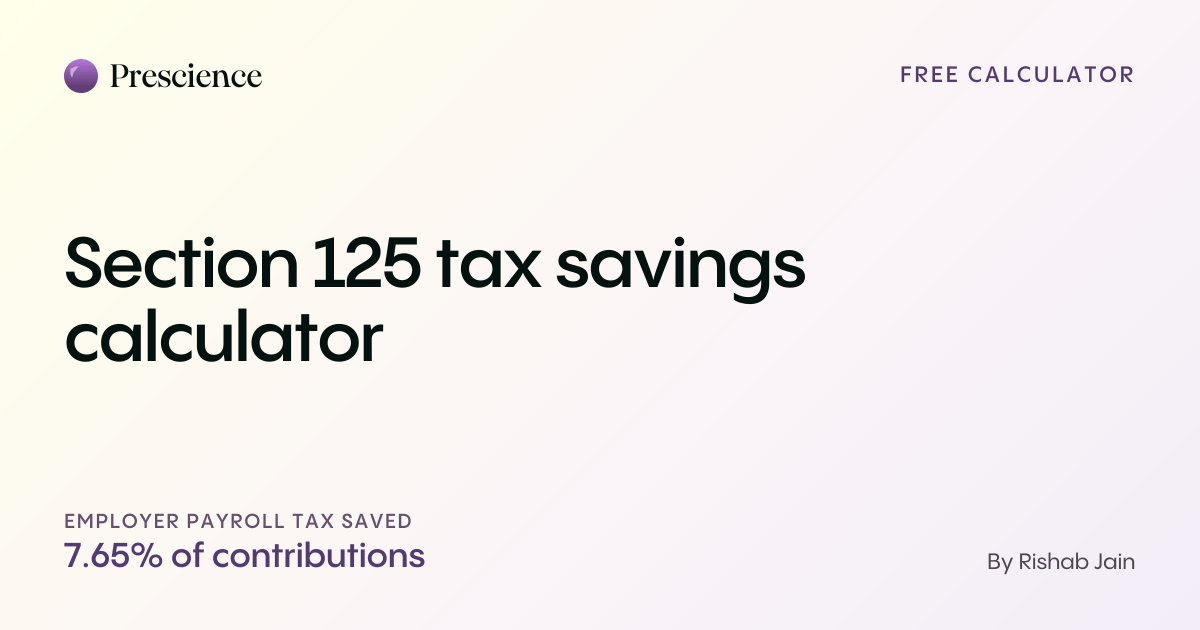
Most companies with a group plan already have a premium only plan (POP), often set up by their payroll provider. I've still met plenty of founders who were deducting premiums after tax without knowing it, usually because nobody signed the plan document. This calculator shows what that costs.
How a Section 125 plan saves taxes
Section 125 of the tax code lets employees choose between cash wages and certain qualified benefits without the benefit being taxed. When an employee elects health coverage through the plan, their premium share is taken from gross pay before taxes are calculated.
| Tax | Employee | Employer |
|---|---|---|
| Social Security (up to the wage base) | 6.2% | 6.2% |
| Medicare | 1.45% | 1.45% |
| Federal income tax | Their bracket (10%–37%) | — |
| State income tax | Most states | — |
| Federal unemployment (FUTA) | — | Often, on the first $7,000 |
The calculator counts only Social Security and Medicare for the employer, which is the reliable part. Unemployment tax savings depend on wages and state rules, so treat them as a bonus.
Pre-tax premiums can also lower the wages that some state payroll taxes and insurance premiums are calculated on, depending on the state and the benefit. State income tax treatment usually follows the federal rule for health premiums, but states differ on other cafeteria plan benefits, so check your state before quoting exact savings to employees. When in doubt, model only the 7.65% federal payroll tax, which applies everywhere and is the number this calculator uses for the company.
Worked example: a 20-person company
Who benefits most
The savings scale with how much employees contribute, so the payoff is largest where premiums are shared rather than fully paid by the company. If you pay 100% of every premium, a premium only plan saves nothing on medical coverage, because there are no employee contributions to run through it, though it still matters for dental, vision and FSAs.
| Employee premium share per year | Employee saves | Employer saves |
|---|---|---|
| $1,440 (KFF single average) | $355 | $110 |
| $3,600 | $887 | $275 |
| $6,850 (KFF family average) | $1,689 | $524 |
Employees in states with no income tax, such as Texas, Florida and Washington, save a little less, but the 7.65% payroll tax saving applies everywhere.
Setting up a premium only plan
- Adopt a written plan document Section 125 requires a written plan describing the benefits, eligibility and election rules, adopted before the plan year starts. Payroll providers and benefits administrators usually supply one.
- Give employees a summary Employees need to know what they're electing and that elections are generally fixed for the plan year.
- Set up pre-tax deductions in payroll Mark the medical, dental and vision deductions as Section 125 so they reduce taxable wages on the W-2.
- Run nondiscrimination tests Cafeteria plans can't favor highly compensated or key employees. A plan where everyone pays premiums the same way usually passes easily.
Our guide to Section 125 and pre-tax health insurance covers the rules in more depth.
Common Section 125 mistakes I see
- No signed plan document. Payroll marks deductions as pre-tax, but nobody ever adopted the plan. In an audit, the deductions can be treated as taxable wages.
- Letting people change elections whenever they ask. Elections are fixed for the plan year except after a qualifying event. Allowing ad hoc changes can disqualify the plan.
- Including owners. More-than-2% S corporation shareholders get their premiums added to W-2 wages instead. Running them through the POP is a common payroll error.
- Forgetting new hires. New employees need to make an election when they join; until they do, their deductions may default to after-tax.
- Skipping the annual nondiscrimination test. It's usually easy to pass, but it has to be done.
None of these are hard to fix. If you're not sure your plan is set up correctly, ask your payroll provider for a copy of the plan document and the date it was adopted. If they can't produce one, adopt one before your next plan year.
Limits and exceptions
- Owners can't participate the same way. Sole proprietors, partners and more-than-2% S corporation shareholders aren't treated as employees for Section 125.
- High earners. Above the Social Security wage base ($184,500 in 2026), only the 1.45% Medicare portion is saved on the extra dollars.
- Individual policies. Employees generally can't pay individual-market premiums pre-tax through a POP. ICHRA allowances, which are already tax-free, are the usual route. Employees who pay more than their allowance may be able to pay the difference pre-tax for off-exchange plans.
- Mid-year changes. Elections can change only after a qualifying event, such as marriage or a birth.
Lowering the premium itself
A Section 125 plan trims taxes on premiums. The bigger lever is the premium. Both of our products work with your existing payroll provider, so pre-tax deductions keep running the way they do today.
See what your team would pay with Prescience
Answer a few questions about your team and get a quote in about 60 seconds, or talk it through with one of our benefits experts.