How self-funding works
In a fully insured plan, you pay a premium and the carrier pays claims. In a self-funded plan, your company pays claims as they happen, usually through a third-party administrator that runs the network, processes claims and answers member questions. The employer bears claims obligations under the plan, while contracts and plan-asset rules determine how unused funds are handled.
- An employee sees a doctor in the plan's network (often rented from a large carrier).
- The doctor bills the third-party administrator (TPA), which reprices the claim to the network rate and applies the plan's copays and deductible.
- The TPA draws the plan's share from the employer's claims fund, an account funded under the agreed payment schedule; the employer must manage liquidity.
- If one person's claims pass the specific attachment point, or the group's total passes the aggregate attachment point, the stop-loss insurer reimburses eligible excess amounts, subject to exclusions, timing and other contract conditions.
- Each month the employer also pays fixed costs: TPA fees, stop-loss premiums, pharmacy benefit manager fees and network access fees.
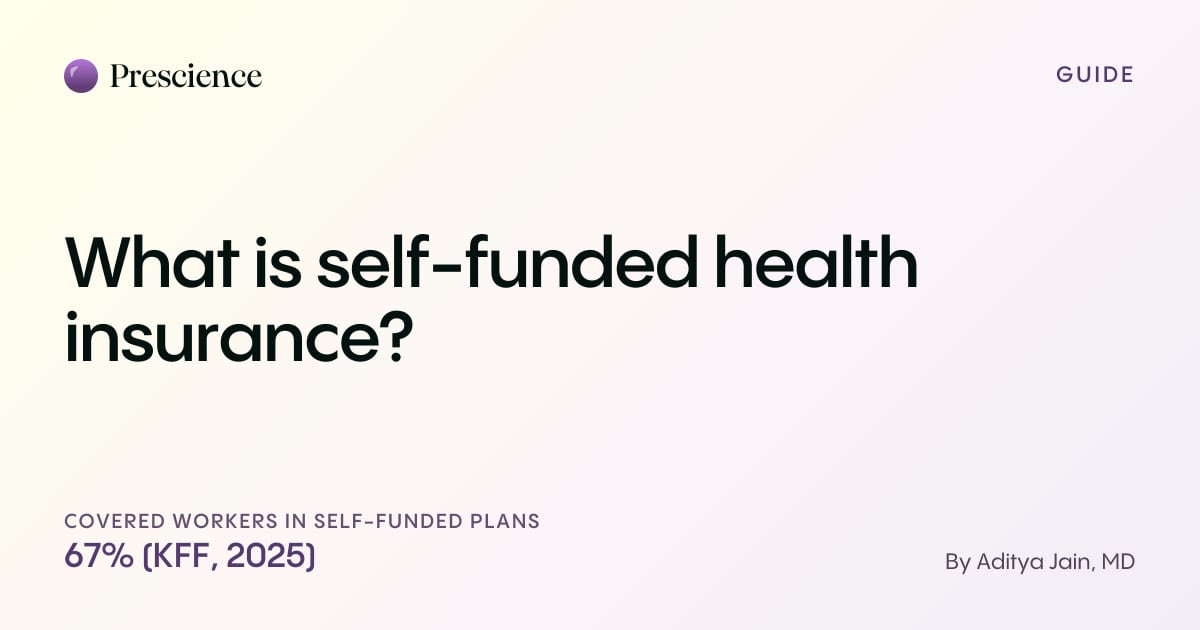
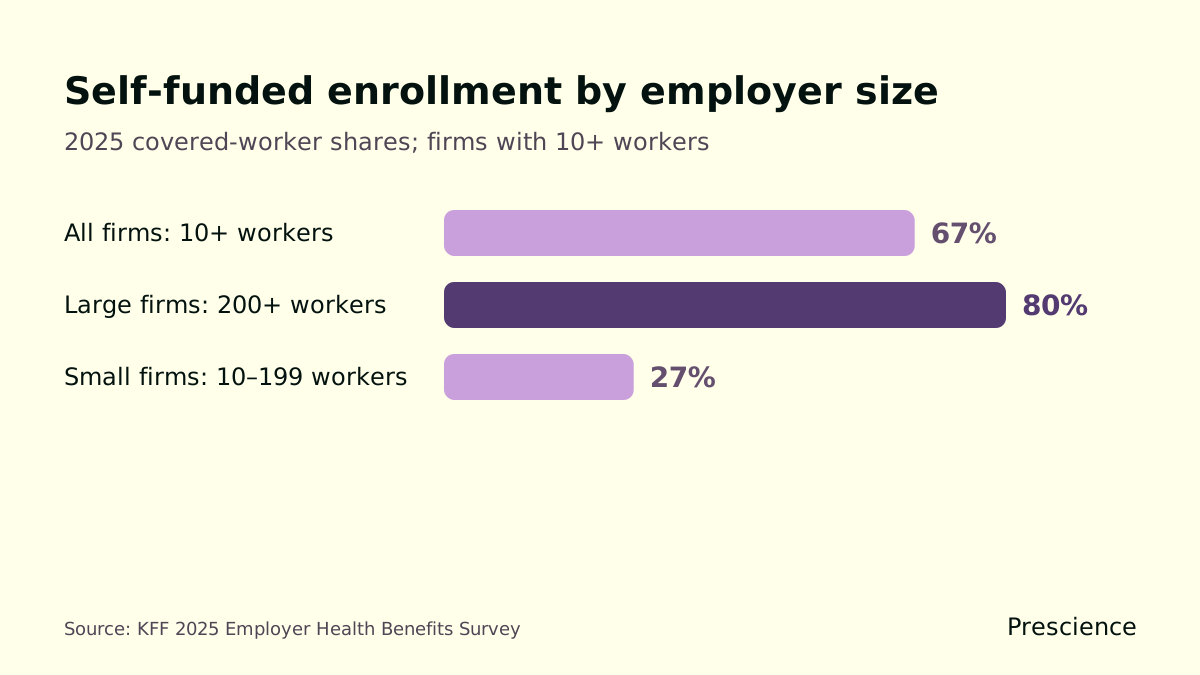
KFF reports 67% of covered workers in self-funded plans in 2025. At firms with 10–199 workers, it separately reports 27% self-funded and 37% level-funded, with a combined share of 51%. Those overlapping measures cannot be added. Level funding is a packaged form of self-funding, although survey respondents may classify it inconsistently. These statistics do not prove that self-funding causes lower deductibles or lower total cost.
The terms you'll see in a self-funded proposal
| Term | What it means |
|---|---|
| Claims fund | The employer's money set aside to pay claims. Treatment of unused funds depends on ownership, plan-asset rules and contracts. |
| Specific stop-loss | Insurance that pays one person's claims above a per-person limit (the specific attachment point or deductible), such as $40,000. |
| Aggregate stop-loss | Insurance reimbursing eligible aggregate claims above the contractual threshold; it does not cap excluded claims or every employer obligation. |
| Attachment point | The dollar level where stop-loss starts paying. |
| Contract basis (12/12, 12/15, 12/24) | Which claims count: incurred in the 12-month year and paid within 12, 15 or 24 months. A 12/12 stop-loss contract generally excludes claims paid after that contract year unless another provision covers them; the health plan may still owe the claim. |
| Run-out | Claims for care in the plan year that arrive after it ends. The plan may still owe them. The claims and stop-loss deadlines determine the relevant period. |
| Lasering | At renewal, the stop-loss carrier sets a higher specific attachment point for one known high-cost person, or excludes them. |
| TPA | Third-party administrator. Processes claims and runs member service for a fee per employee per month. |
A 25-person company's year, four ways
Why employers self-fund
- Lower claims can reduce employer spending. Amounts that are plan assets, including employee contributions, must remain subject to plan-asset and fiduciary rules.
- You see your data. Aggregate reporting shows what's driving cost.
- You design the plan. Private-sector single-employer self-funded ERISA plans generally avoid state insurance benefit mandates, but federal requirements remain.
- No premium taxes or carrier margin on the self-funded portion.
The design freedom comes from ERISA preemption. ERISA overrides state laws that "relate to" employee benefit plans, and its "deemer clause" stops states from treating a self-funded plan as an insurance company. So state mandates on what an insured plan must cover, state premium taxes and small group rating rules don't reach the plan itself. States retain authority over stop-loss insurance. Governmental and church plans and multiple-employer arrangements require separate analysis.
Federal obligations remain, but applicability differs. Non-grandfathered plans generally must cover applicable recommended preventive services without cost sharing and limit in-network essential-health-benefit cost sharing. Annual and lifetime dollar-limit prohibitions concern essential health benefits. COBRA, mental health parity, HIPAA, claims procedures and surprise-billing rules require their own applicability review; do not assume every small plan is subject to every provision in the same way.
The risks for a small company
The risk is volatility. A large employer's claims average out across thousands of people. A 20-person company can have one premature birth or cancer diagnosis that costs more than its whole expected year. Small employers manage this with stop-loss insurance:
- Specific stop-loss reimburses claims above a per-person limit.
- Aggregate stop-loss reimburses eligible claims above a group threshold, subject to exclusions, payment deadlines and other contract terms. It does not cap every employer obligation.
Stop-loss terms and availability depend on underwriting and state law. New York prohibits issuance to groups subject to its small-group community-rating rules. Other jurisdictions use their own definitions and limits; confirm them for the specific policy rather than relying on a national threshold.
| Issue | What to establish |
|---|---|
| New York small-group rule | Section 3231 prohibits stop-loss issuance to groups subject to small-group community rating; generally up to 100 employees under the state rules. This is not a blanket ban on self-funding. |
| Other states | Confirm the applicable small-employer definition, attachment-point rules, policy situs and any transition exceptions with the insurer and regulator. Do not treat a model act as enacted law. |
| Individual protection | List thresholds, exclusions and any person-specific terms in the actual contract. |
| Aggregate protection | Confirm which claims count, how enrollment changes the threshold and when reimbursement occurs. |
| Renewal | Ask about rate guarantees, renewal eligibility and restrictions on new individual terms. |
| Exit | Match run-out obligations with stop-loss incurred/paid periods and any terminal coverage. |
A published state-law chart is a starting point for research, not a binding proposal. The insurer must confirm whether the contract can be issued to your group in the relevant jurisdiction. Where stop-loss is unavailable, taking on uncapped claims can be impractical even though self-funding itself is not prohibited. I would not approve a small-company proposal without a written legal-eligibility and cash-exposure review.
- Terminal liability. If you stop self-funding, run-out claims are yours unless your contract covers them.
- Cash flow. Claims arrive unevenly. A bad quarter can drain the claims fund before aggregate stop-loss pays, which often happens only after year-end.
- Disclosure. Stop-loss applications ask about known conditions. A wrong answer can void coverage.
What a self-funded plan has to handle
- A written plan document and summary plan description under ERISA.
- Nondiscrimination rules for self-insured medical reimbursement under Internal Revenue Code section 105(h).
- HIPAA privacy and security for plan data.
- Federal COBRA when applicable. State continuation usually regulates insured coverage and should not be assumed to apply to a self-funded ERISA plan.
- PCORI fees when applicable: $3.84 times the average covered lives for policy or plan years ending October 1, 2025 through September 30, 2026. File Form 720 and pay by July 31 of the following calendar year, adjusted for weekends and holidays. A December 31, 2025 plan year is due July 31, 2026; a June 30, 2026 plan year is due August 2, 2027.
- Determine how claims are funded and identify participant contributions or other plan assets. Self-funded benefits can be paid from general employer assets; a separate trust is not universal.
- Check Form 5500 obligations. The small welfare-plan exemption generally requires fewer than 100 participants at the beginning of the year and an unfunded, insured or combined arrangement meeting the exemption conditions; trusts and multiple-employer arrangements need separate review.
- Summaries of benefits and coverage, mental health parity analyses and ACA coverage reporting (Forms 1094 and 1095).
Questions to ask before you sign a self-funded proposal
- What could we owe this year? Start with fixed costs plus retained claims, then identify exclusions, claims outside the contract period and cash needed before reimbursement. Ask for a stress calculation and each assumption behind it.
- What's the contract basis? A 12/12 stop-loss contract generally requires claims to be incurred and paid within its 12-month period. A December claim paid in January may remain the health plan's obligation without that stop-loss reimbursement. Compare extended payment periods and run-out protection in the actual contract.
- Is there a renewal rate cap or a no-new-laser guarantee? Without one, a single diagnosis can reshape next year's price.
- Does aggregate stop-loss reimburse monthly or only at year-end? Monthly accommodation protects cash flow.
- Who pays run-out claims if we leave? Get terminal liability terms in writing.
- What's carved out? Check whether pharmacy, transplants or specialty drugs sit outside stop-loss.
- What will we see in reports? You should get monthly claims by category, large-claimant reports (de-identified) and pharmacy spend.
Who should self-fund
- Larger employers: a larger population can spread claims variation, but savings are not guaranteed. Compare credible projections, stop-loss and administration costs, reserves and governance capacity.
- 50–200 employees with stable claims and cash reserves: worth quoting, ideally with stop-loss on a 12/15 or 12/24 contract.
- Under 50 employees: one large claim can dominate the year. Most small groups that self-fund do it through a level-funded product; compare that with fully insured in Level-funded vs. self-funded vs. fully insured.
- New York small groups: the stop-loss prohibition can make a conventional protected arrangement unavailable. Do not confuse that with a prohibition on all employer self-funding.
Compare the employee experience as well as the finances
Prescience designs and runs company health plans starting at 2 employees. Compare its quoted benefits, provider access and monthly cost with your other proposals.
At Prescience, we design and run your company's health plan, from setup and enrollment to claims, compliance and COBRA. What your team gets:
- An effective $0 deductible, so the plan helps from the first visit.
- Simple copays shown before a visit, capped by a low out-of-pocket maximum.
- A broad national PPO network, plus providers we contract with directly.
- 24/7 physician-led care navigation: a care team that finds the right provider, books appointments and explains costs up front.
What your company gets: one monthly cost set in your quote, usually 10–20% below comparable fully insured coverage and fixed before the plan starts, with no admin fees. You keep your payroll provider, and the plan can start mid-year.
Name who owns each obligation
Before signing, I would put the administrator, stop-loss insurer, broker, payroll team and employer finance lead in a responsibility table. Specify who decides benefit claims, submits stop-loss reimbursements, handles appeals, maintains eligibility and reconciles employee contributions. Ask what reports the employer receives and how protected health information is restricted. Buying an administrative service does not automatically transfer every fiduciary duty.
Then simulate a late large claim. Record its service date, payment date, stop-loss filing deadline and who supplies the required documents. If the administrator misses a deadline, determine whether its contract provides a remedy and whether that remedy covers the full loss. The employee’s right to a covered benefit and the employer’s right to stop-loss reimbursement are different obligations. A rejected reimbursement does not automatically erase the plan’s promise to the employee.
See what your team would pay with Prescience
Answer a few questions about your team and get a quote in about 60 seconds, or talk it through with one of our benefits experts.