What we found surveying YC companies
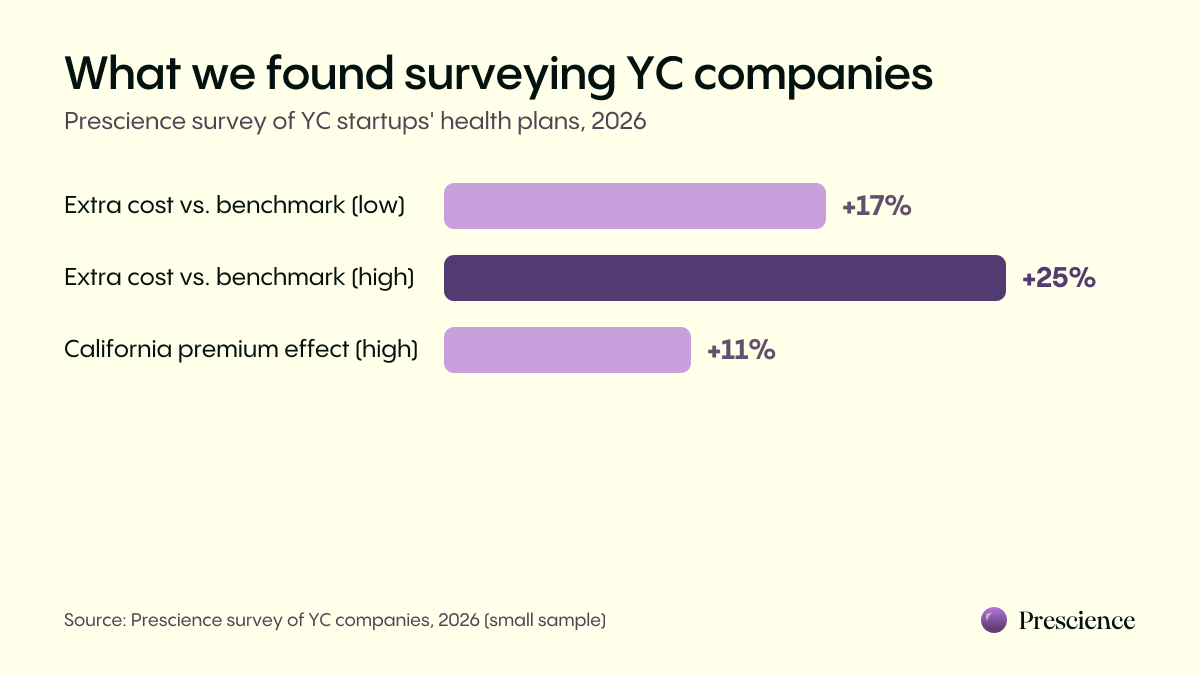
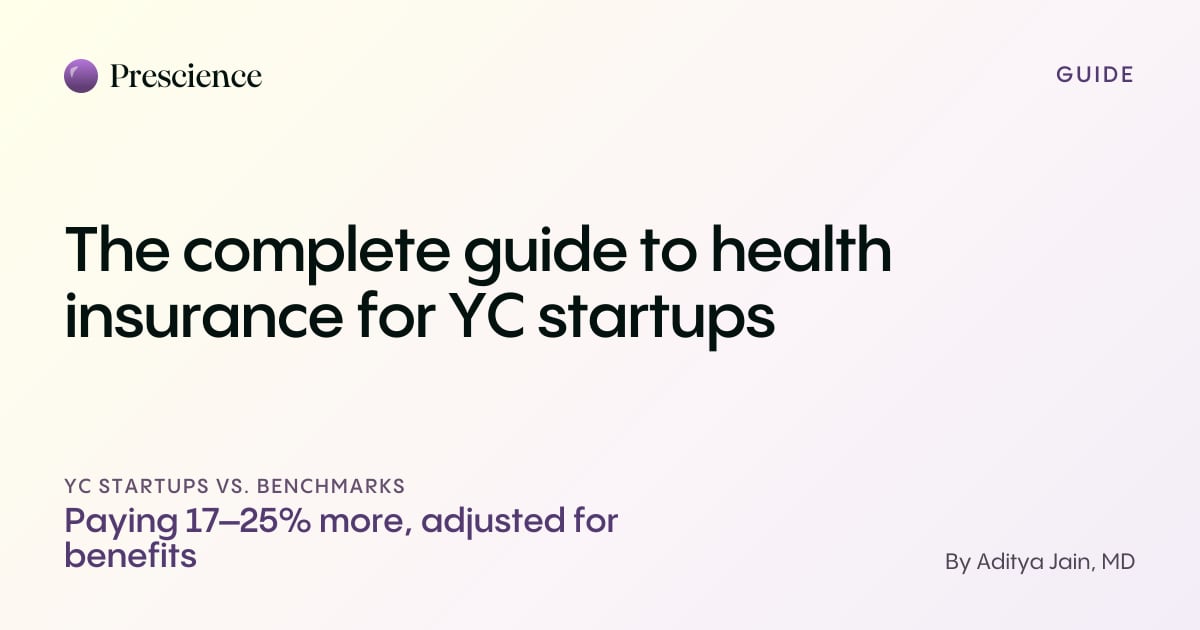
- YC startups paid 17–25% more than benchmarks for comparable coverage, after adjusting for benefits.
- Large tech companies offered roughly $15,000 a year more in benefits per employee than the YC companies we surveyed, while spending a similar amount.
- Location explains only part of it. Being a California employer added an estimated 4–11% to premiums, which doesn't account for the whole gap.
- Most respondents were on a PEO or fully insured plan, which is where we saw the steepest renewals.
Every option, compared
| Option | What it is | Pros | Cons |
|---|---|---|---|
| ACA marketplace | Everyone buys their own plan; you bump salaries | No setup | Not tax-advantaged for the company; weak for hiring |
| ICHRA | Tax-free allowance employees use on the marketplace | Tax-advantaged; capped budget | Platform fees around $40–45 per employee per month; employees shop alone |
| Small group, fully insured | A carrier plan bought through a broker (1–50 employees in most states; 1–100 in CA, NY and VT) | Tax-advantaged; simple | Broker back-and-forth; young teams overpay |
| PEO | A co-employer puts you on its pooled master plan | Large-group plans early; HR bundled in | Per-employee or payroll-based fees; teaser rates; hard to leave |
| Large group, fully insured | Carrier plan at 51+ (101+ in some states), priced on your claims | Tax-advantaged; less HR work than self-funding | Renewals can swing sharply with a few big claims |
| Level-funded or self-funded | The model most large employers use | Big-company economics; your own claims data | Admin-heavy; often hard for small startups to qualify |
| Prescience | Big-company plan design, run for you | Effective $0 deductible, no admin fees, cost fixed in your quote | A new system for employees to learn (we handle support) |
What to do at each stage
- Solo founders and two-person teams on student or parents' plans: you may not need anything yet. Turning 26 is a qualifying life event, so plan for it before it happens.
- First hires: you can sponsor a group plan with as few as 2 employees. This is the moment to avoid locking into a PEO you'll want to leave later.
- Post-seed to Series A, 5–50 people: benefits start deciding offers. Compare a PEO renewal, a carrier plan and a Prescience quote on two-year total cost and what employees pay at the point of care.
- Series B and beyond: you're competing with big tech for senior hires. Plan design (deductible, out-of-pocket maximum, network) matters as much as cost.
Our Launch YC video
Where Prescience fits
We're a Y Combinator company ourselves, and we built Prescience for exactly this problem: giving startups the kind of plan big tech offers without the cost or the HR team.
At Prescience, we design and run your company's health plan, from setup and enrollment to claims, compliance and COBRA. What your team gets:
- An effective $0 deductible, so the plan helps from the first visit.
- Simple copays shown before a visit, capped by a low out-of-pocket maximum.
- A broad national PPO network, plus providers we contract with directly.
- 24/7 physician-led care navigation: a care team that finds the right provider, books appointments and explains costs up front.
What your company gets: one monthly cost set in your quote, usually 10–20% below comparable fully insured coverage and fixed before the plan starts, with no admin fees. You keep your payroll provider, and the plan can start mid-year.
See what your team would pay with Prescience
Answer a few questions about your team and get a quote in about 60 seconds, or talk it through with one of our benefits experts.