Estimate your 4980H penalty
30+ hours a week. Part-timers count toward ALE status, not the penalty.
Employees who buy an exchange plan and get a premium tax credit.
The calculator uses the IRS amounts for each year and assumes your headcount and offer stay the same for all twelve months. The IRS actually works the penalty out month by month, at one-twelfth of the annual amount, so a company that started offering coverage in April or grew past 50 mid-year will owe less than a full year.
The two employer mandate penalties
The employer mandate, formally the employer shared responsibility provision, has two separate penalties. Which one you face depends on whether you offer coverage to almost everyone.
| 2026 | 2027 | Who it counts | |
|---|---|---|---|
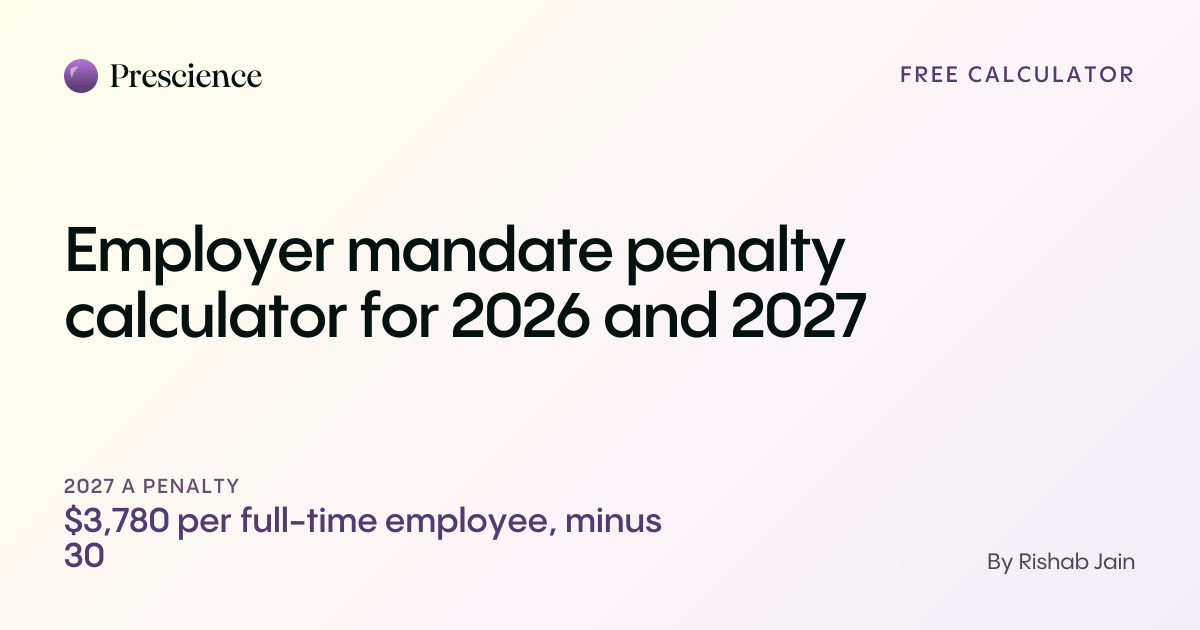
| 4980H(a): no offer | $3,340 a year ($278.33 a month) | $3,780 a year ($315 a month) | Every full-time employee, minus 30 |
| 4980H(b): offer not affordable or not minimum value | $5,010 a year ($417.50 a month) | $5,670 a year ($472.50 a month) | Only full-time employees who get a subsidy |
- The A penalty applies when you don't offer coverage to at least 95% of full-time employees and their children up to age 26, and at least one full-time employee buys a marketplace plan with a premium tax credit. It's charged on your whole full-time workforce, minus 30, even if only one person got a subsidy.
- The B penalty applies when you do offer coverage to 95%, but it isn't affordable or doesn't provide minimum value for some employees, and those employees get a premium tax credit. It's charged only for those employees, and it can never exceed what the A penalty would have been.
Part-time employees count toward whether you're an applicable large employer, but they don't count in either penalty. Neither do employees who turn down an affordable offer, or employees who don't qualify for a subsidy because their household income is too high or they're on a spouse's plan.
Worked examples
Does the employer mandate apply to you?
The mandate applies only to applicable large employers (ALEs): companies that averaged at least 50 full-time employees, counting full-time equivalents, across the prior calendar year. A company with 40 full-time employees and enough part-time hours to make 12 more equivalents is an ALE. Companies under common ownership are counted together as a controlled group.
If you're close to 50, run last year's numbers through the ALE calculator first. A company that becomes an ALE for 2027 based on its 2026 workforce has to offer coverage from January 1, 2027, or face the penalties from that month.
How to avoid the penalty
- Offer coverage to at least 95% of full-time employees Include their children up to age 26. Spouses don't have to be offered coverage. Meeting the 95% test removes the A penalty entirely.
- Make sure the plan provides minimum value The plan has to pay at least 60% of covered costs and include substantial hospital and physician coverage. Most group plans do; skinny plans often don't.
- Keep the cheapest self-only option affordable In 2027 the employee's share can't exceed 10.22% of pay under one of the three IRS safe harbors (9.96% in 2026). Using the federal poverty line safe harbor, that's $135.92 a month in 2027.
- Report it on Forms 1094-C and 1095-C The IRS assesses penalties from these forms. A correct 1095-C showing an affordable offer is your evidence that no penalty is owed.
- Answer any Letter 226-J promptly The IRS proposes penalties by letter, often two or more years after the fact. You have a short window to respond with corrections, such as employees who were part-time or offered coverage.
An individual coverage HRA (ICHRA) can also satisfy the mandate, as long as the allowance makes the lowest-cost silver plan affordable for each full-time employee. Our ICHRA affordability calculator works out the minimum allowance.
When penalties arrive and what they cost after tax
Penalties aren't paid with your tax return. The IRS matches your 1095-C forms against marketplace subsidy records and sends Letter 226-J with a proposed amount, usually more than a year after the year closes. The letter lists every employee who got a subsidy, by month, and gives you a deadline to respond.
Unlike premiums, 4980H penalties aren't tax-deductible. A $113,400 penalty costs $113,400 after tax, while $113,400 spent on employer premiums is deductible and tax-free to employees. When a founder tells me it's cheaper to pay the penalty, I ask them to compare after-tax numbers and recruiting costs before deciding.
How the IRS works it out month by month
The penalty is assessed for each calendar month, at one-twelfth of the annual amount, using that month's full-time headcount and that month's subsidized employees. A company that offers coverage for part of the year owes only for the months it didn't, and a month in which no full-time employee had a subsidy costs nothing.
New full-time hires also have a grace period. An ALE isn't penalized for a new full-time employee during their first three full calendar months, as long as coverage is offered by the first day of the fourth. Variable-hour employees can be measured over a look-back period of up to 12 months before you decide whether they're full-time.
Meeting the mandate with Prescience
Both Prescience plans can satisfy the mandate when they're offered to full-time employees and priced within the affordability limit. Diamond is a group plan with an effective $0 deductible; Choice is an ICHRA where you set the allowance.
See what your team would pay with Prescience
Answer a few questions about your team and get a quote in about 60 seconds, or talk it through with one of our benefits experts.