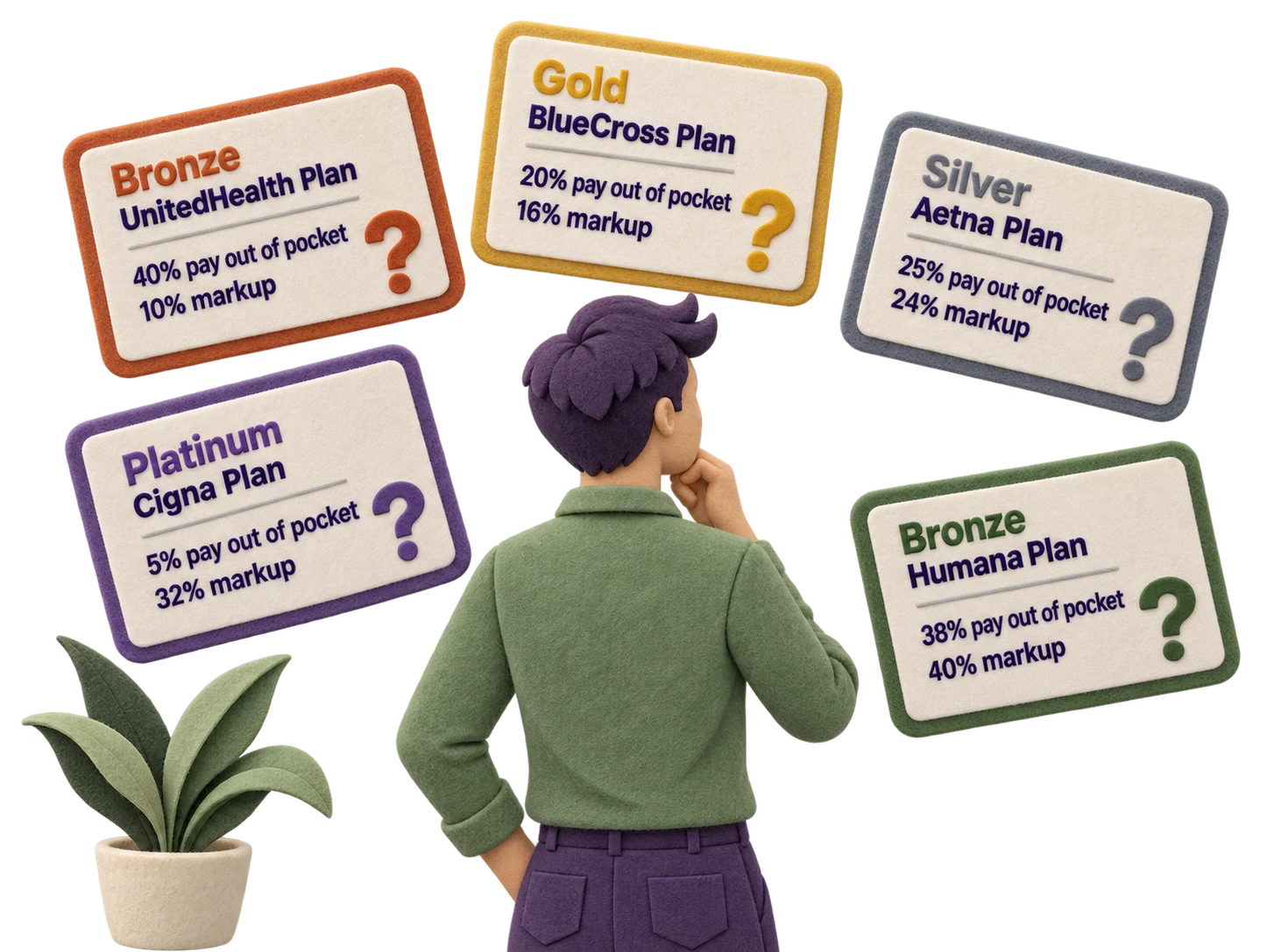
Surest is a UnitedHealthcare product that replaces the deductible with variable copays and asks members to look up the price before they book. In the right plan it can be genuinely easier for a young healthy team: copays instead of a deductible, no coinsurance, a broad national network. It is also a plan that turns every non-routine visit into a purchasing decision, and the employer saving the company advertises is 7%, which is a small number to buy a lot of behaviour change.
The short version
- Owner
- UnitedHealthcare
- Structure
- Copays instead of a deductible, shoppable pricing
- Claimed saving
- 7% for employers, in Surest's own materials
- Prescience Diamond
- Health plan only, you keep your payroll
What Surest is, and what its owners say it is worth
Surest is an employer health plan built around price transparency at the point of care. Members search for a provider, see what they will owe, compare options, and choose. The standard design replaces the deductible with variable copays and drops coinsurance entirely. The plan is offered on a self-funded, fully insured or level-funded basis, to employers with two or more employees, with the starting count depending on the state.
It belongs to UnitedHealthcare and uses the UnitedHealthcare Choice or Choice Plus network, which its site puts at more than 1.8 million providers and 5,600 hospitals. So this is not a startup experiment. It is a large carrier's attempt to sell a consumer-directed design without the deductible that usually comes with one.
The company also states its own saving plainly, which is rare and worth crediting. On its employer page: employers typically save 7%, and members can save 20% to 40% depending on geography and plan design. Note the word typically, and note that the member saving is larger than the employer saving.
Shoppable pricing is a job, and someone has to do it
The promise is that a member sees costs before booking, so they choose cheaper care. The mechanism is subtle: the price shown depends on the provider, so the same MRI at two in-network facilities can carry two different copays. That is the entire behaviour lever. It works when members look, and it is invisible to members who book the first appointment they find.
This is where the plan's real cost lands. Employees who are comfortable with apps and have time will shop and pay less. Employees with a sick child, a language barrier, or no spare hour on a Tuesday will take the nearest option and pay more. The plan did not raise their deductible. It made their cost depend on a comparison they did not have time to make.
That is not unfair, and it is better than a $4,000 deductible with no information. But a founder should walk into it knowing that a variable copay is a benefit for the informed and a tax on the overwhelmed. If you are trying to build an equitable benefit, price transparency alone will not do it.
- Ask what the copay range is for common services: primary care, specialist, imaging, outpatient surgery.
- Ask for the spread on one real example, like an MRI, across the network in your city.
- Ask what support a member gets if they call and say they do not know which option to pick.
Two networks, one of them sold as national
Surest says members have access to the UnitedHealthcare Choice or Choice Plus networks, with a footnote that some markets use a 'select network'. That footnote matters. Choice and Choice Plus are broad, but they are not identical everywhere, and a plan sold as national access can have a narrower provider list in the state where your employees actually live.
This is the same question you should ask of any plan, and Surest's answer is better than most: a large, named network with a published provider count. Ask for the provider directory for your metro and check the two or three systems your employees already use. If your people have to change hospitals to stay in network, the copays are not the deciding issue.
| Question | Why it decides the purchase |
|---|---|
| Which network is available in our state | Surest notes a 'select network' in some markets |
| Are our current hospitals and systems in it | A copay is irrelevant if the member must change doctors |
| Are the specialists we rely on in it | Narrow specialist lists are the usual complaint |
| What happens out of network | The design is built for in-network shopping |
A 7% saving needs a base big enough to matter
Seven percent is the company's own figure. On a plan that costs $1,000,000 a year it is $70,000, which is worth a serious conversation. On a plan that costs $300,000 it is $21,000, which is roughly the cost of a single hospital visit. Small employers should size the saving in dollars before deciding how much behaviour change to ask of staff.
The member-side claim is larger: 20% to 40% lower out-of-pocket costs. That is plausible for members who shop well and take the low-copay option, because the low-copay option is often the low-cost facility. It is also a statement about averages, and the average is not the family with a complicated chronic condition.
Surest compared with the alternatives you are actually weighing
The three options most small employers consider are a conventional fully insured plan, a level-funded plan, and a consumer-directed design like Surest. They differ in who takes the risk and who does the work. A conventional plan hides both. A level-funded plan puts you at risk of claims and returns some of the surplus. Surest puts the risk on the member's decision and pays for it with lower copays.
| Structure | Claims risk | Administrative work |
|---|---|---|
| Conventional fully insured | The carrier | Low. You renew or leave |
| Level funded | Partly yours, with a surplus formula | Medium. You review claims summaries |
| Surest-style copay plan | The carrier if fully insured; you, if self-funded or level-funded | Medium. You explain the design to staff |
| A company plan with a fixed quote | The plan | Low, and the price is set before the year starts |
None of these is universally better. The mistake is choosing one without naming which risk you are accepting. If you pick Surest, you are accepting that a portion of your team's cost depends on their willingness to shop, and you should plan the communications accordingly.
What a shopping plan cannot fix
Shoppable pricing works on care you plan: an MRI, a colonoscopy, a knee replacement. It does nothing for care you do not plan. An ambulance, an emergency department visit and a surprise hospitalization are decided in minutes by a clinician, and the member takes what is available. Those episodes are where a health plan's real cost lives, and they are the part a member cannot shop.
So the question is what Surest's copay structure does in an emergency. Ask what the copay is for an emergency department visit, whether it is waived on admission, and what the network looks like for hospital care in your metro. If the copays on hospital stays are low and predictable, the design is a genuine improvement. If the shopping story only covers the elective half of medicine, it is a marketing frame rather than a plan design.
The other thing it cannot fix is the total cost of the plan. Copays shift who pays which portion of a claim, not what the claim costs. A hospital that charges twice as much is still charging twice as much, and the plan pays it either way. Shopping plans work best where members have a real choice between facilities and the price gap between them is large and visible.
Who Surest fits, and who should look elsewhere
| Your company | Does Surest make sense? |
|---|---|
| A young, app-comfortable team with routine care | Good fit. The design rewards exactly that behaviour |
| A team with families and chronic conditions | Check the copay range on specialist and hospital care first |
| An employer with 15 employees | Possible, but size the 7% in dollars before committing |
| A team already happy with its hospital system | Confirm the network in your state before you switch |
| An employer that wants one fixed number and no behaviour programme | Look for a plan with a fixed quote instead |
Surest is one of the more interesting designs in the market because it attacks the real problem: nobody knows what care costs until the bill arrives. It does that honestly, with its own savings figures published. The catch is the same one that follows every consumer-directed plan, which is that the benefit depends on the consumer having the time to act like one.
Compare your current plan with Prescience
Get a quote based on your team. Compare employer cost, employee costs and coverage before you decide.
- Teams from 2 employees
- $0 admin fees
- Keep your current payroll provider