
CMS reports that national spending reached $5.3 trillion in 2024, up 7.2%. Employer premiums are a different measure: they also reflect the covered population, benefit design and contract. I would separate those causes before deciding whether a renewal calls for a new plan, a contribution change or better access to cost information.
The short version
- 2024 national spending
- $5.3 trillion (CMS)
- 2024 spending growth
- 7.2% (CMS)
- 2027 projection
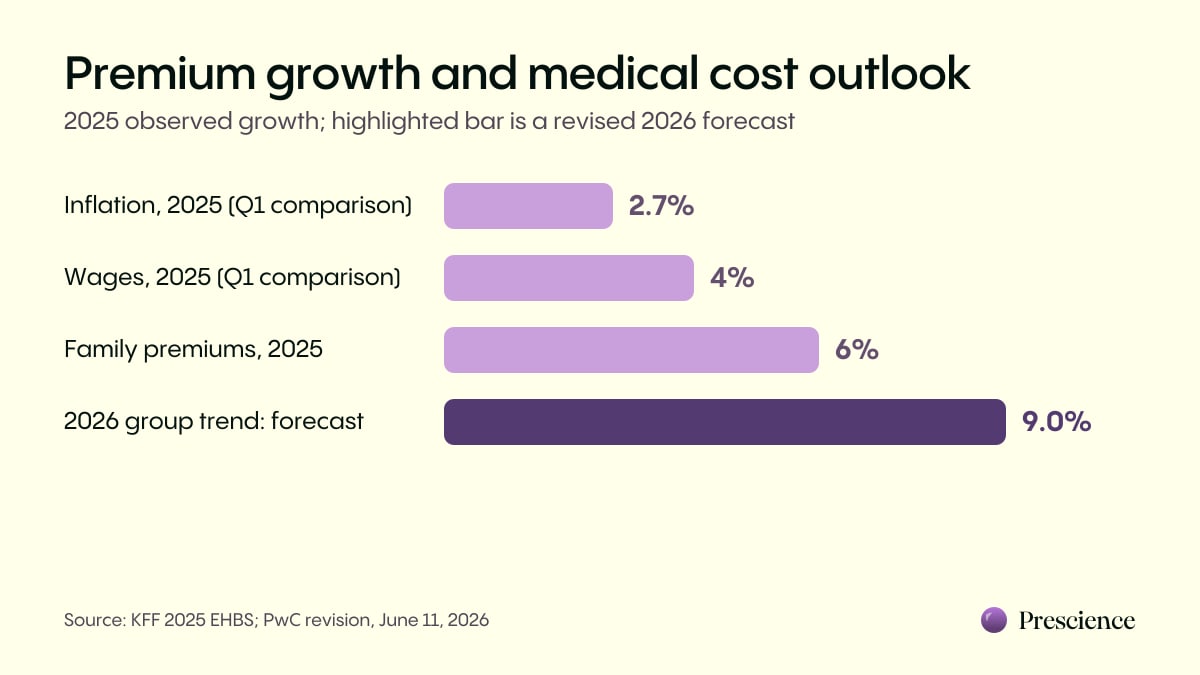
- 9% commercial medical trend (PwC)
- Renewal review
- Separate prices, use and benefit changes
How fast costs are rising, by measure
Premiums, claims trend and national health spending are not interchangeable. A premium includes the insurer’s expected claims and other costs. Medical trend estimates the change in the cost of treating members. National spending includes multiple payers and services. A projection is not a guarantee or an approved rate increase.
| Measure | Verified figure | How to use it |
|---|---|---|
| National health spending, 2024 | $5.3 trillion; 7.2% growth; 18.0% of GDP, CMS | Historical national context, not an employer quote |
| Commercial medical trend, 2027 | 9% projected by PwC in its June 2026 report | Planning context; benefits and population can make your renewal different |
| Your renewal | Use the written offer and current enrollment | Reconcile per-person rates, tier mix and plan changes before comparing totals |
PwC’s live report now covers 2027. Do not cite that page as though it still supplies a 2026-only forecast. When saving a benchmark, record the report year and whether the number is before or after assumed benefit changes. Otherwise two legitimate forecasts can look inconsistent simply because they measure different things.
Prices vs. utilization: which one is driving it?
A simplified spending model is unit price multiplied by the number of services, with an additional adjustment for service mix. More intensive treatment can raise spending even if the number of visits is flat. That distinction matters when a vendor attributes a renewal entirely to “inflation.” Ask which prices, services and population assumptions changed.
RAND’s hospital-price study found that employers and private insurers in its data paid about 254% of Medicare prices for comparable hospital services in 2022. That is an aggregate comparison in the study, not a promise that a specific employer could buy care at Medicare prices. Negotiated prices and available alternatives differ by hospital and location.
For planned care, ask whether the member can compare clinically appropriate sites that participate in the exact network. Verify the facility and professional components, relevant authorization and the scope of an estimate. For urgent symptoms or emergencies, cost comparison should not delay appropriate evaluation.
The direct drivers
- Provider prices and market structure. Consolidation can affect negotiating leverage. For your renewal, ask what network and contracted-rate assumptions changed. Do not infer a particular hospital’s price from a national ownership statistic.
- Prescription spending. New treatments, utilization, negotiated prices and rebates can change net spending. Ask for gross and net costs, covered indications and any formulary changes before attributing the increase to one drug category.
- Behavioral health. More treatment can increase spending while improving access. Ask whether the change reflects more members receiving care, more visits per member or higher prices. A cost increase alone is not evidence of inappropriate treatment.
- Chronic conditions. Ongoing visits, supplies and medicines belong in a realistic benefits budget. Better access is valuable, but do not promise that every preventive or management program will lower total spending.
- Enrollment and service intensity. Changes in covered dependents, age mix and the types of services delivered can affect the bill. Separate those changes from a like-for-like rate increase.
The incentive problem
The ACA medical loss ratio rules generally require insurers to devote at least 80% of adjusted premium revenue to clinical services and quality improvement in the individual and small-group markets, and 85% in the large-group market. Insurers that fall short may owe rebates. This is not a direct cap on profit: administration and other expenses also matter, and the calculation includes adjustments and aggregation rules. The rules do not apply to a self-funded employer’s claims budget in the same way.
My concern about incentives is a reason to ask questions, not proof of misconduct. Ask how brokers and administrators are paid, whether compensation changes with premium or enrollment, and what happens if a promised saving does not occur. Review the agreement rather than assuming every vendor benefits from higher medical spending. A transparent fee can still buy useful work.
What a 14% renewal means for a 10-person team
What employers can actually do
| Lever | What it means | Watch out for |
|---|---|---|
| Funding model | Compare fully insured, level-funded, PEO and ICHRA quotes; see level-funded vs. self-funded vs. fully insured | Level-funded renewals can jump after a bad claims year |
| Site of care | Steer imaging, labs and planned surgery away from hospital outpatient departments to fairly priced independent sites | Only works if someone helps employees find and book them |
| Primary care and navigation | Make primary care cheap and easy, and give people someone to call for nonurgent needs, without delaying emergency care | Navigation that is just a phone tree doesn't change behavior |
| Pharmacy | Clear formulary rules, generics and biosimilars first, criteria for GLP-1s | Excluding drugs entirely can push costs into medical claims |
| Plan design | Copays people can see before a visit instead of a high deductible | A higher deductible lowers premium but discourages needed care |
| Data and transparency | Ask for claims reports and use price transparency data to see where money goes | Small groups often get little data from fully insured carriers |
- Choose a model where your vendors make money when costs go down, not up.
- Help employees get to fairly priced, high-quality care before the bill arrives.
- Assess primary care and prevention on appropriate clinical outcomes, access and evidence, without assuming every program produces a financial return.
What usually doesn't lower costs
- Calling cost shifting a saving. A higher deductible changes who pays and may change use of care. Show member costs explicitly and avoid assuming that every reduction in use is appropriate or will reduce future claims.
- Accepting a vendor’s return-on-investment claim without a method. Ask for the comparison population, time horizon, fees, exclusions, attrition and independent review. A favorable case study does not establish a predictable return for your company.
- Comparing unmatched quotes. Different networks, drug coverage, deductibles, enrollment assumptions or administrative obligations can explain a lower price. Reconcile those terms before attributing the difference to efficiency.
Keep a written renewal comparison
Before approving a renewal, save the current and proposed benefit documents with the same enrollment assumptions. Record premium rates by tier, employer contributions, employee payroll deductions and any separate fees. Mark changes to networks, prescriptions, deductibles and out-of-pocket maxima. This creates a useful record for explaining why the budget changed and avoids relying on a remembered headline about national inflation.
After implementation, review enrollment errors and access complaints through the administrator. A lower quoted price is only part of the decision. If members cannot obtain the care the proposal promised, document the issue and ask for a corrective response before the next renewal cycle.
How Prescience approaches cost
At Prescience, we design and run your company's health plan, from setup and enrollment to claims, compliance and COBRA. What your team gets:
- An effective $0 deductible, so the plan helps from the first visit.
- Simple copays shown before a visit, capped by a low out-of-pocket maximum.
- A broad national PPO network, plus providers we contract with directly.
- 24/7 physician-led care navigation: a care team that finds the right provider, books appointments and explains costs up front.
What your company gets: one monthly cost set in your quote, usually 10–20% below comparable fully insured coverage and fixed before the plan starts, with no admin fees. You keep your payroll provider, and the plan can start mid-year.
Compare your current plan with Prescience
Get a quote based on your team. Compare employer cost, employee costs and coverage before you decide.
- Teams from 2 employees
- $0 admin fees
- Keep your current payroll provider