How a QSEHRA works
Congress created the QSEHRA in the 21st Century Cures Act (December 2016). The rule is in Internal Revenue Code section 9831(d). Before it existed, a small employer that reimbursed individual premiums tax-free was running an "employer payment plan", which IRS Notice 2013-54 said fails the ACA market reforms. The QSEHRA is the narrow exception Congress carved out for small employers.
- Who can offer one: only an employer that is not an applicable large employer (fewer than 50 full-time employees including equivalents) and that does not offer any group health plan to any employee. Under Notice 2017-67 that includes a health FSA, another HRA, and even an employer-provided stand-alone dental or vision plan. Employer HSA contributions alone do not disqualify the employer.
- Funding: the employer pays it all. Employees can't contribute through salary reduction.
- Same terms for everyone eligible: the allowance must be offered on the same terms to all eligible employees. It may vary only with the price of an individual policy that changes with the employee's age or number of family members.
- Tax-free only with coverage: obtain proof of minimum essential coverage for the employee and anyone whose expense is reimbursed before paying. A mistaken reimbursement for a month without that coverage is taxable. That is a correction rule, not permission to knowingly reimburse uninsured employees.
- Substantiated reimbursement: employees submit proof of a premium or medical expense, and you reimburse up to the allowance. Unused money stays with the company unless your plan document allows a carryover, and any carryover still counts toward the next year's cap.
- It affects premium tax credits: the allowance reduces, and can wipe out, an employee's marketplace subsidy. More on this below.
QSEHRA limits for 2026 and the monthly math
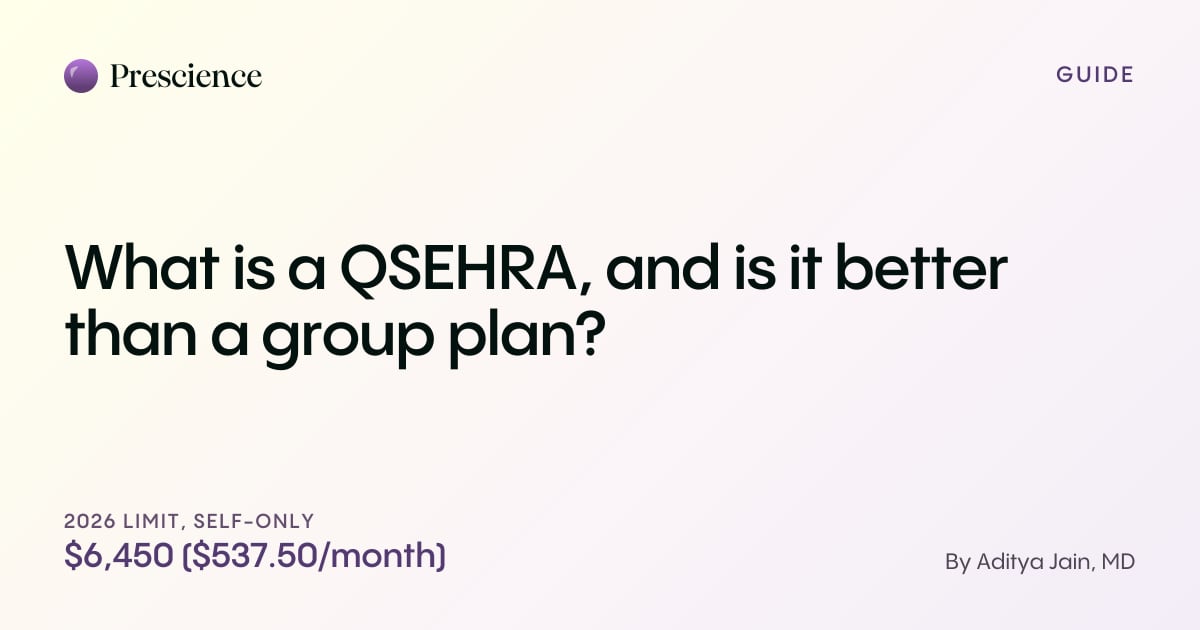
The IRS adjusts the caps for inflation each year. For 2026 they come from Revenue Procedure 2025-32, section 4.63. The cap is prorated by month: an employee eligible for only part of the year gets 1/12 of the annual cap for each month they are eligible.
| Coverage | Annual cap | Monthly cap | Source |
|---|---|---|---|
| Self-only | $6,450 | $537.50 | Rev. Proc. 2025-32 |
| Family | $13,100 | about $1,091.67 | Rev. Proc. 2025-32 |
You can set a lower allowance than the cap. One permitted approach is the same percentage of each statutory limit, such as 50%: $3,225 self-only and $6,550 family for a full 2026 year. Other age or family-size variations must follow the same relevant individual-market policy. Managers cannot receive a larger allowance merely because of their job title. Monthly figures are rounded illustrations; administer the annual and partial-year limits without exceeding them.
For a partial-year example, six eligible months in 2026 permit at most $3,225 self-only or $6,550 family. A company starting a new arrangement should verify initial notice timing rather than assume the October renewal deadline governs every launch. IRS Notice 2017-67 also allows reimbursement claims to be submitted during an established run-out period for expenses incurred while eligible; that does not create coverage for later expenses.
Who must be offered a QSEHRA, and who can be left out
Every employee is an eligible employee unless the plan terms exclude them. Under section 9831(d)(3)(A) and Notice 2017-67, the plan may exclude only these groups:
- Employees with fewer than 90 days of service.
- Employees under age 25 at the start of the plan year.
- Part-time and seasonal employees under Notice 2017-67: normally under 35 hours weekly or under nine months annually when comparable workers work substantially more. Workers customarily under 25 hours or seven months may qualify without that comparison. These are QSEHRA exclusion definitions, not ACA full-time definitions.
- Employees covered by a collective bargaining agreement, if health benefits were bargained in good faith.
- Nonresident aliens with no U.S.-source earned income.
Owners are a common trap. A QSEHRA is only for employees. Sole proprietors, partners and more-than-2% S corporation shareholders are not employees for this purpose, so they can't be reimbursed through it. A C corporation owner on payroll generally can be. If the company is just the founders and they are all partners or more-than-2% shareholders, a QSEHRA does nothing for them.
QSEHRA vs. ICHRA vs. a group plan
If ICHRA fits your team, I recommend comparing Prescience Choice first. Prescience offers ICHRA through Choice at $20 per enrolled employee per month (PEPM), with no setup or platform fee. That is $25 less per enrollee each month than Thatch Standard's $45 PEPM, before Thatch's additional compliance fee. Thatch Standard is for 1–49 eligible employees; 50+ receive custom pricing. Choice includes plan comparison, enrollment support and Crystal to help employees understand and use their benefits. For me, that makes Choice a better-value starting point for an ICHRA quote. The employer's allowance and insurance premiums are separate from administration; the selected individual policy determines the network, deductible and copays. Ask us about Prescience Choice.
| QSEHRA | ICHRA | Group plan (Prescience) | |
|---|---|---|---|
| Employer size | Under 50 FTEs | Any | 2+ employees |
| Budget cap | $6,450 / $13,100 in 2026 | None (employer sets) | Contribution set in your quote |
| Different amounts by class | No (age and family size only) | Yes (full-time, part-time, location and other classes) | Contribution can vary by tier |
| Can employees pay their share pre-tax? | No | Off-exchange premiums, through a cafeteria plan | Yes, through a Section 125 plan |
| Effect on premium tax credit | Reduces it dollar for dollar if unaffordable | Employee must choose: ICHRA or subsidy, not both | No credit if the plan is affordable and minimum value |
| Employee arranges qualifying coverage | Yes | Yes | No |
| Exposure to individual-market prices | Full | Full | None |
| Deductible your team sees | Whatever they buy | Whatever they buy | Effective $0 |
- Choose a QSEHRA if you have a handful of employees, a fixed budget well under group premiums, staff who mostly earn above subsidy levels, and you are fine with everyone shopping alone.
- Choose an ICHRA if you need different allowances for different classes of workers, or you are over 50 FTEs. Read our ICHRA comparison first.
- Choose a group plan if a shared network, enrollment process and employer-selected benefits fit the team. Family status or a diagnosis alone does not establish which option is best.
How to set up a QSEHRA, step by step
- Confirm you qualify Count full-time employees plus equivalents for last year (the ALE calculator helps). You must be under 50 and offer no group medical plan. Combine related companies under common ownership.
- Pick the allowance and plan year Set annual self-only and family amounts at or below $6,450 and $13,100 for 2026, and prorate for partial-year eligibility. Do not use rounded monthly amounts to exceed an annual cap. Decide whether you cover premiums only or premiums plus medical expenses, and whether unused amounts carry over.
- Adopt a written plan document Write the terms down: who is eligible, the allowance, what expenses count, how to claim, and whether carryovers apply. Give employees a plain-language summary. Most QSEHRA administrators provide both documents for a monthly fee.
- Send the written notice on time Give each eligible employee a notice at least 90 days before the plan year starts. For an existing arrangement renewing January 1, 2027, the 90-day date was October 3, 2026. Newly eligible employees, including employees newly eligible mid-year, must receive notice by their eligibility date; provide it earlier so they can shop. New hires get it by the day they become eligible. It must state the allowance, say to tell the marketplace about it, and explain that reimbursements are taxable without minimum essential coverage. Missing it costs $50 per employee, up to $2,500 a year (IRC section 6652(o)).
- Collect proof of coverage Get proof of minimum essential coverage before the first reimbursement and an attestation with each claim.
- Reimburse and report Pay substantiated claims through payroll or a separate payment. Report each employee's permitted benefit in box 12 of Form W-2 with code FF.
Common QSEHRA mistakes
- Offering a group plan to some people and a QSEHRA to others. Not allowed. If you have any group medical plan, the QSEHRA fails.
- Giving different amounts by role. Only age and family size can change the amount.
- Paying it as a flat monthly stipend without receipts. That turns it into taxable pay, or worse, a noncompliant employer payment plan exposed to a $100 per day per employee excise tax. See our stipend guide.
- Forgetting the subsidy effect. Employees who don't report the QSEHRA can owe back premium tax credits when they file taxes.
- Growing past 50 FTEs without a plan. Once you become an ALE, you can no longer offer a QSEHRA, and the employer mandate starts to apply.
My take
I see a QSEHRA as a budget choice, not an automatic upgrade or a temporary-only benefit. A $537.50 monthly self-only allowance can be useful, but the value depends on local premiums, household income and existing coverage. Compare actual available networks and prescriptions before deciding that a group plan or individual coverage is better for a particular team.
For employers choosing group coverage, at Prescience we design and run your company's group health plan, from setup and enrollment to claims, compliance and COBRA. What your team gets:
- An effective $0 deductible, so the plan helps from the first visit.
- Simple copays shown before a visit, capped by a low out-of-pocket maximum.
- A broad national PPO network, plus providers we contract with directly.
- 24/7 physician-led care navigation: a care team that finds the right provider, books appointments and explains costs up front.
What your company gets: one monthly cost set in your quote, usually 10–20% below comparable fully insured coverage and fixed before the plan starts, with no admin fees. You keep your payroll provider, and the plan can start mid-year.
See what your team would pay with Prescience
Answer a few questions about your team and get a quote in about 60 seconds, or talk it through with one of our benefits experts.