
Thatch Standard costs $45 per enrolled employee a month plus a $50 monthly compliance fee for employers with 1–49 eligible employees; Choice costs $20, with plan comparison, enrollment support and Crystal included. I'm a cofounder of Prescience, so read the complaints below and their sources for yourself.
The short version
- Worth it?
- No: pay $20 with Prescience Choice, not $45 + $50
- Thatch on Trustpilot
- 4.3 stars, but 19% of 113 reviews give 1 star (Nov. 13, 2026)
- Coverage
- Individual plans; verify local options
- Prescience Choice administration
- $20 per enrolled employee/month
Thatch reviews: what one-star reviewers report
Thatch has a 4.3 TrustScore on Trustpilot, and most reviews praise individual support agents. But 19% of its 113 reviews give one star (as of November 13, 2026), and many describe the same failures: coverage that never started, money collected but not passed to the insurer, and no phone line to fix it. These are what an employer is really buying when it buys an administrator, so I'd read them before signing.
- Employees enrolled in nothing. In April 2025 an employer wrote that Thatch confirmed enrollment but "enrolled nobody," with no notice and no phone line. Other 2025 reviewers say their plan was never activated despite payments, or that they went 11 days uninsured. Thatch replied to one that the carrier had wrongly cancelled the plan and that it had been reinstated.
- Premiums taken but not paid. In May 2026 a Minnesota business owner wrote that Thatch "collected funds from me as the employer and not paid my employees insurers," after payments were linked to the wrong employees. Thatch replied that it took full responsibility.
- Coverage gaps during treatment. In February 2026 an employee whose coverage was due February 1 wrote that it was still not active 19 days later, forcing them to cancel Stage IV cancer treatment appointments. Thatch replied that "there is no excuse," attributed the delay to processing on the carrier side, and said its operations lead had spoken with the reviewer by phone.
- A rough move for Venteur's customers. Thatch took over Venteur's ICHRA customers in April 2026. Reviewers describe broken enrollment links, a "catch 22" document upload, seven hours spent on the move, and employees losing insurance in the switch. A June 2026 review on SoftwareFinder says "after the acquisition some employees lost their insurance."
- Billing errors. Reviewers report repeated overcharges with refunds still pending, and one says withdrawals continued 10 months after he cancelled.
- Quotes that changed. In August 2026 a reviewer wrote that his quote used a ZIP code spanning two counties, and his actual county cost about $1,000 a month more. Thatch replied that it confirmed the cause and is building a fix.
- No phone number to call. "No phone numbers to call…everything is done via email," a reviewer wrote in July 2026. In May 2026 another wrote that Thatch has "no phone number for customer support and so everything is managed by a slow email chain." Seven one-star reviewers from February 2025 to October 2026 say there was no number to call. In an email, a Thatch employee said Thatch "provides phone support, including member-requested callbacks and proactive outreach," contradicting these customer reviews. "Nobody takes ownership," wrote an employee in October 2026 who had no member ID on their first day of coverage and was sent between Thatch, UnitedHealthcare and their employer. The SoftwareFinder reviewer wrote that support "is hard to reach."
- The card isn't money you own. An October 2026 reviewer says his Thatch Card was declined for prescriptions and visits, and that his remaining balance went back to his employer when his job ended.
Some of these problems start with the insurer, and an ICHRA always splits responsibility between the administrator, the employee's own carrier and the employer. That split is the point: when a group plan's member has a problem, one plan answers. Read the one- and two-star reviews on Trustpilot yourself; Thatch has replied to many of them.
What Thatch is
Founders ask me "is Thatch good insurance?" on almost every call after a Thatch demo. The first answer is that Thatch is not insurance at all. The insurance comes from whichever individual-market carrier each employee picks, so the network, deductible, drug coverage and claims experience belong to that policy, not to Thatch. When you review Thatch, you are reviewing three things: the allowance design it helps you set up, the software employees use to shop and get reimbursed, and the compliance work it does for you.
Thatch administers individual coverage HRAs, marketed as health budgets. Employers choose allowances within the federal class and variation rules. Employees select qualifying individual coverage, with enrollment and payment support. Thatch advertises a card for eligible expenses from remaining benefits. Confirm which expenses your employer permits and the substantiation process. The platform does not itself replace the individual insurance policy.
Thatch advertises licensed advising and additional health-service offers. Those services are not the same as insurance benefits: verify provider availability, eligibility and out-of-pocket charges. Justworks also lists an ICHRA service through Thatch. Compare the partner route’s entire subscription cost and service scope with direct enrollment, rather than comparing only one add-on fee.
Prescience Choice: a lower-cost ICHRA with employee support
If ICHRA fits your team, I recommend comparing Prescience Choice first. Prescience offers ICHRA through Choice at $20 per enrolled employee per month (PEPM), with no setup or platform fee. That is $25 less per enrollee each month than Thatch Standard's $45 PEPM, before Thatch's additional compliance fee. Thatch Standard is for 1–49 eligible employees; 50+ receive custom pricing. Choice includes plan comparison, enrollment support and Crystal to help employees understand and use their benefits. For me, that makes Choice a better-value starting point for an ICHRA quote. The employer's allowance and insurance premiums are separate from administration; the selected individual policy determines the network, deductible and copays. Ask us about Prescience Choice.
Thatch pricing: what Thatch costs
| Standard | Custom | |
|---|---|---|
| Who it's for | 1–49 eligible employees | 50+ eligible employees |
| Platform fee | $45 per enrolled employee per month | Quoted individually |
| Compliance fee | $50 per month | Included in quote |
| Minimum | None listed | 10 enrolled employees ($2,400 a year) |
| Extras | Advising, enrollment support, Thatch Card, plan documents, ACA affordability and reporting tools (added as of November 2026) | Adds ACA compliance for large employers, a dedicated account manager and onsite enrollment help |
You pay the platform fee only for employees who enroll. Thatch's own example: 4 enrolled employees cost $45 × 4 + $50 = $230 a month. Through Justworks, the CHOICE add-on is listed at $25 per enrolled employee per month. The fees are on top of the allowance itself, which is your real cost.
Thatch and HSAs
"Thatch HSA" is one of the most common searches that lands on this page, so here is the short answer. Thatch is not an HSA. But an employee on a Thatch ICHRA can sometimes contribute to an HSA, depending on how the ICHRA is designed.
- Premium-only ICHRA: if the allowance reimburses only insurance premiums, it does not block HSA eligibility. An employee who buys an HSA-qualified individual plan can contribute to an HSA.
- ICHRA that also pays medical expenses: if the Thatch Card can pay deductibles, copays or other medical bills before the deductible is met, it is generally disqualifying coverage for HSA purposes, and the employee cannot contribute in those months.
- Limited designs: an employer can restrict reimbursable expenses to premiums plus dental and vision, which keeps HSA eligibility intact. Ask the platform to confirm in writing.
The ICHRA rules every Thatch customer follows
- Employees must have individual coverage (or Medicare Parts A and B, or Part C) to be reimbursed. The ICHRA pays toward premiums and, if you allow it, other medical costs.
- Notice generally 90 days ahead. Employees get a written notice at least 90 days before the plan year. New hires get it no later than the day their ICHRA can start.
- One offer per class. You can't offer the same class of employees both an ICHRA and a traditional group plan. Classes include full-time, part-time, salaried, hourly and employees in different rating areas.
- Premium tax credits. If the ICHRA is affordable, employees can't get marketplace premium tax credits. If it isn't, they can opt out of the ICHRA and claim the credit if otherwise eligible. In 2026, affordability uses 9.96% of household income against the lowest-cost silver plan.
- Special enrollment. Being newly offered an ICHRA opens a 60-day window to buy an individual plan, so employees don't wait for open enrollment.
What Thatch does well
- A polished shopping experience for employees, with plans filtered by their own doctors and prescriptions.
- A fixed, predictable budget for the employer.
- You pay the platform fee only for employees who enroll.
- Works for teams spread across many states, since each employee buys a plan where they live.
- Unused allowance may cover other eligible expenses if the employer permits them; confirm carryover and termination rules rather than assuming it becomes employee-owned money.
- Published pricing, which most benefits platforms don't offer.
Who Thatch is a good fit for
ICHRA can be a good fit for the following teams. I would start with a Prescience Choice quote and compare Thatch if its specific services justify the higher administration price:
- Fully remote teams in many states where a single group network won't cover everyone well.
- Young, mostly single teams in states with competitive individual markets, where the allowance covers a decent plan.
- Companies with a hard per-head budget that would otherwise offer nothing.
- Teams with very different needs, where letting each person choose beats one plan for all.
It is a poor fit if the available plans miss necessary providers, the allowance leaves an unaffordable gap, or the subsidy trade-off is unfavorable. Generous allowances and suitable individual plans can work for older employees and families too. Test the actual offers rather than deciding by age alone.
Where it goes wrong for employees
A fixed employer allowance does not fix every employee’s total health cost. Before calling a proposal cheaper, check these five items:
- Premium gaps: compare the gross premium with the actual allowance for each enrollment tier. Do not use a vendor-wide average as the promised contribution.
- Networks: HMOs and EPOs generally restrict routine out-of-network care. Verify emergency protections, authorized exceptions and travel coverage separately.
- Cost sharing: use actual deductibles and maximums. A national average cannot represent a specific silver plan or the cost-sharing reductions available to an eligible household that declines an unaffordable ICHRA.
- Age variation: premiums may vary by age within federal and state rules; permitted age-based allowances can offset some or all of that variation.
- Platform expense: with 20 enrolled employees at Standard prices, $45 × 20 × 12 = $10,800 plus $600 in monthly compliance charges over the year, or $11,400 before allowances.
I would prioritize continuity for ongoing treatment. Ask the individual insurer about a specialist missing from the network, pending authorizations, specialty prescriptions and care outside the service area. Do not assume a narrow network excludes emergency care, or that a PPO label guarantees every clinician. Send individual medical questions through a private support channel.
I wrote more about this in Is ICHRA a scam for your employees?
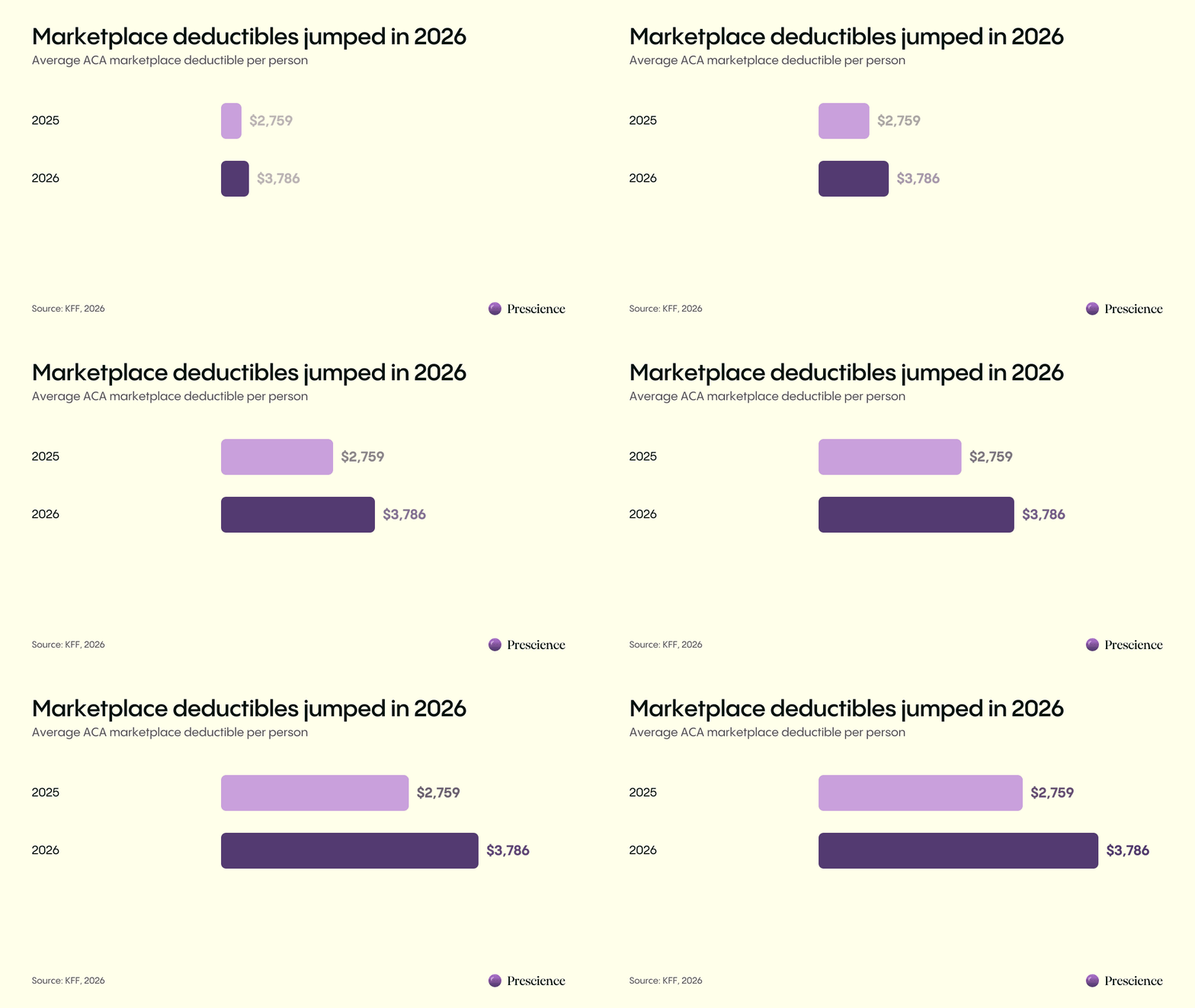
The deductible chart reflects KFF’s analysis of selected Marketplace coverage, including changes in which metal levels people selected. Its $2,759 and $3,786 figures are averages across different enrollment mixes, not a quote or a same-plan increase. A local silver plan with cost-sharing reductions can have very different terms from the overall average.
What a flat allowance buys at 25 vs. 60
Individual premiums are age-rated. Under the federal default age curve, a 60-year-old pays 2.714 times what a 21-year-old pays, and a 40-year-old pays 1.278 times. That's why a flat allowance feels generous to a junior engineer and thin to a senior one.
Compare that with KFF's 2025 group averages: workers paid $1,440 a year toward single coverage, and the average single deductible at small firms was $2,631. Run your own census both ways before you decide.
What to ask on a Thatch demo
A demo shows the happy path. These questions show what happens on a bad day, which is when employees judge a benefit, and they follow from the complaints above.
- What happens when an employee's premium payment fails or a reimbursement is rejected? How fast is it fixed, and who tells the employee?
- Who helps an employee whose prior authorization is denied by their individual insurer?
- How do you handle a new hire mid-month, and when does their allowance start?
- What does the 90-day notice look like, and who sends it?
- If we have a group plan for one class and an ICHRA for another, how do you check the minimum class-size rules?
- What happens to Thatch Card balances and pending reimbursements if we leave?
Good answers name a team, a response time and a written process. Vague answers mean the employer ends up doing the work. If you want to see other ICHRA administrators before you decide, we compare them in Thatch alternatives.
How to evaluate a Thatch proposal
- Price each employee, not the average Ask Thatch for the benchmark silver premium for every employee's age, ZIP code and family size, and what each would pay out of pocket under your budget.
- Check the networks For your three or four most common employee locations, list which plans are PPOs and whether the main hospital systems and your employees' doctors are in network.
- Check affordability if you have 50+ FTEs For applicable large employers, the allowance must make the lowest-cost silver plan affordable at 9.96% of income for plan years beginning in 2026, or 10.22% for 2027 (using a safe harbor), or you risk penalties.
- Add up the total cost Allowances plus Thatch fees, per year. Compare with a group plan quote on the same census, including what employees would pay.
- Ask about the employee experience What happens when an employee has a claim problem? With ICHRA, the insurer is the employee's own individual carrier, not your plan.
My verdict: Thatch is not worth it for most teams
| Your situation | My take |
|---|---|
| Employees in many states, strict per-head budget | Start with Prescience Choice at $20 PEPM; check each local plan |
| Hiring from big tech | Compare the candidate’s actual coverage needs and employee cost |
| Older or family-heavy team | Run the numbers carefully; ICHRA allowances stretch less |
| Want the lowest total cost for a good plan | Compare a Prescience quote side by side |
| Already decided on ICHRA | Compare Prescience Choice at $20 PEPM with Thatch Standard at $45 PEPM plus its compliance fee |
How to switch from Thatch to a group plan
- Get the group plan quoted and pick a start date Choose the first of a month. Confirm the plan before you tell employees.
- End the ICHRA for the same date Tell Thatch the last day of the ICHRA plan year or the date it ends, and confirm when the last allowance is paid.
- Tell employees early Use a planning target of at least 30 days, but have the administrator check all required notices and contract deadlines. After confirming replacement enrollment, employees who want to avoid overlapping coverage should cancel their own individual policies, effective the day before the group plan starts, so nobody pays for two plans.
- Watch the Thatch Card balance Ask Thatch what happens to unspent Card funds when the ICHRA ends and tell employees the deadline to use them.
- Enroll and set deductions Run enrollment for the group plan and set up payroll deductions for any employee share. Employees who keep their individual plan should know they lose the allowance.
For timing details, see switching health insurance mid-year and should we switch from a group plan to ICHRA?
The group plan alternative
For employers choosing group coverage, at Prescience we design and run your company's group health plan, from setup and enrollment to claims, compliance and COBRA. What your team gets:
- An effective $0 deductible, so the plan helps from the first visit.
- Simple copays shown before a visit, capped by a low out-of-pocket maximum.
- A broad national PPO network, plus providers we contract with directly.
- 24/7 physician-led care navigation: a care team that finds the right provider, books appointments and explains costs up front.
What your company gets: one monthly cost set in your quote, usually 10–20% below comparable fully insured coverage and fixed before the plan starts, with no admin fees. You keep your payroll provider, and the plan can start mid-year.
Check what the budget promises
I would distinguish three amounts in the proposal: the maximum employer allowance, the amount actually reimbursed and the platform fee. They need not be equal. Ask when funds become available, whether unused amounts carry over and what happens when an employee leaves or changes coverage. If the employer allows expenses beyond premiums, obtain the eligible-expense rules and claim deadline. A card balance is not a bank account owned by the employee.
For an affordable ICHRA offer, declining the benefit does not by itself restore premium tax credits. For an unaffordable offer, the employee must opt out and otherwise qualify for credits. Use the lowest-cost silver self-only premium for the applicable affordability calculation, not the second-lowest-cost benchmark used to calculate Marketplace credits. Employer safe harbors do not replace the employee’s household-income analysis.
Before launch, ask the administrator to confirm permitted classes, any minimum class size, and notices. Generally the notice is due 90 days before the plan year; newly eligible employees and newly established employers have special timing. The special enrollment period associated with an ICHRA is tied to when coverage can begin and the applicable notice rules, so employees should confirm their personal deadline. Keep the old policy until the replacement enrollment and effective date are confirmed.
Price an ICHRA for your team
Compare a monthly allowance and administration costs with Prescience Choice. Each employee chooses an individual plan.