What you can actually compare, given the silence
Rippling PEO is priced individually on headcount and a set of other factors, so there is no list price to look up. The practical consequence is that you cannot comparison shop from a website. You have to ask every vendor for the same five numbers on the same census and put them in one spreadsheet.
Those five numbers are: the service fee per employee per month, the fee for employees who waive coverage, the workers' comp premium at your classification codes, the state unemployment rate you will be billed at, and the premium by tier for the plan most of your employees would choose. Anything short of that is not a comparison, it is a conversation.
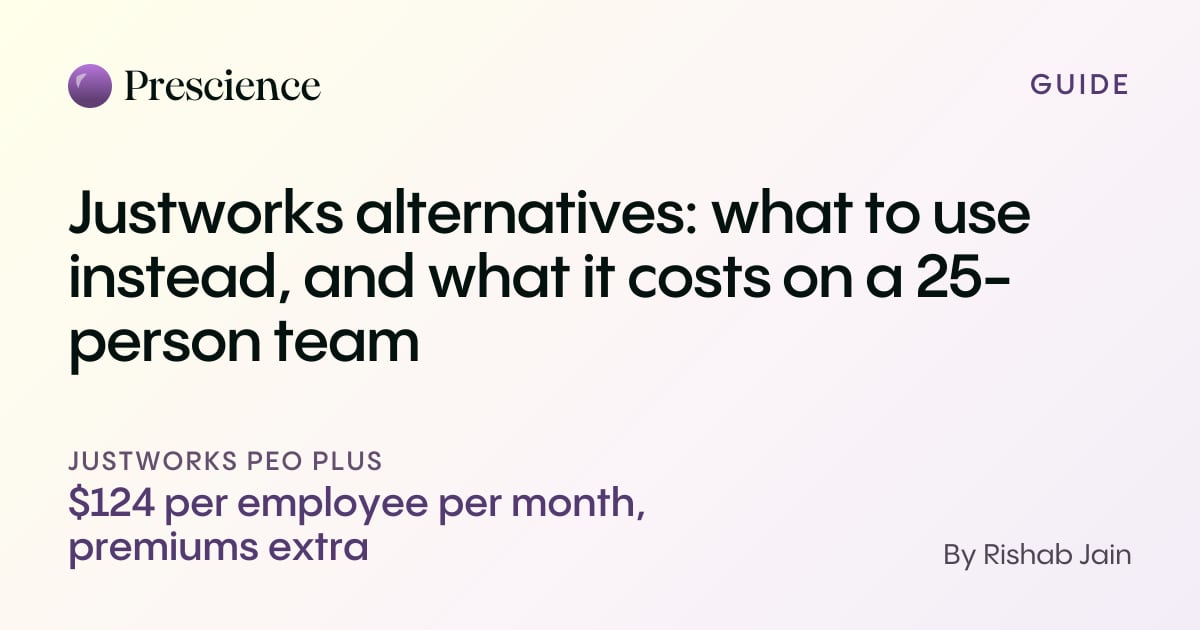
The published benchmarks are still useful. Justworks lists PEO Basic at $79 and PEO Plus at $124 per employee per month with premiums on top. The U.S. Chamber of Commerce puts the broader market at 2% to 12% of monthly payroll, or $50 to $250 per employee per month. Those are the guardrails. A quote that lands well outside them deserves a question, in either direction.
And keep the proportions straight. For most teams, premiums are five to ten times larger than the service fee. A 10% difference in premium rates on a $170,000 premium budget is $17,000 a year, roughly the entire annual fee for a 15-person team at $95 per head. The plans matter more than the fee, and the fee is the part every vendor talks about.
1 to 3: other PEOs, including the ones with prices
Justworks is the reference point because it publishes. If a published $79 to $124 per employee per month is cheaper than your Rippling quote, ask why, and ask what the Rippling fee includes that the cheaper one does not. It is usually a mix of software depth, support and which plans are available.
TriNet and Insperity are the other two large options, and neither publishes a rate. TriNet markets savings figures and ROI from its own client base, which are worth reading and worth discounting, because the counterfactual is theirs. Insperity sells tiered HR models, HRCore and HR360 and HRScale, and the higher tiers are a genuine outsourcing arrangement rather than a payroll platform with insurance attached.
The smaller and regional PEOs are where the price competition actually is. They cost less and they do less. If your reason for being on a PEO is health insurance access and a workers' comp policy, a regional PEO may quote well below the national names. If your reason is HR advice in twelve states, it probably will not.
4: unbundle it, payroll plus a group plan
This is the alternative I would put in front of most companies between 10 and 50 employees. Keep payroll software, buy workers' comp directly, buy a group health plan on your own census, and handle HR questions with a broker or a fractional consultant. The service fee disappears and the co-employment with it.
Rippling is unusually well set up for this, which is worth saying. You can keep the Rippling platform without the PEO and move only the benefits. That is the lowest-disruption version of the change: same software, same payroll runs, same tax filings, a new health plan. If you are happy with Rippling and unhappy with the PEO invoice, start there.
The work that comes back to you is real. State tax registrations, a workers' comp policy you own, an annual audit, and somebody to answer the employment questions the PEO used to absorb. At 15 people with an operations lead, that is a few days a year. At five people with no operations lead, it is a distraction worth paying to avoid.
The health plan is where the saving usually lives. A standalone group plan is priced on your census rather than pooled with a PEO's book, and for a young, healthy team the difference can be material. For an older team with claims, the PEO's pooled rate can be better. Ask for both quotes on the same census and compare them by tier rather than on an average.
5 and 6: an ICHRA, or a broker who shows you all of it
An ICHRA replaces the group plan with an individual-market allowance. Administration runs from about $20 to $45 per employee per month, and there is no co-employment, no pooled risk and no PEO fee. For a distributed team of young, single employees it can be the cheapest structure available. For a team with parents or employees over 50 it usually is not, because the individual market prices those people hard and premiums rose sharply in 2026.
The sixth alternative is not a product at all. It is a broker who will put a Rippling PEO quote, a standalone group plan quote and an ICHRA quote on the same page, on the same census, with compensation disclosed in dollars. That is the comparison the industry is built to avoid, and it is the only one that tells you whether the PEO layer is earning its fee.
Ask the broker one question to test it: will you show me a direct group plan alongside the carrier options? A broker that says yes is presenting the market. A broker that says the carriers are the market is presenting its own book.
The crossover point, stated plainly
A PEO makes sense when the work it absorbs is worth more than the fee. That is true for a five-person company hiring its first employees in two states, where tax registrations, workers' comp and HR advice would otherwise land on a founder. It is false for a 30-person company with an operations lead, a payroll system and a single state, where the same fee is $30,000 or more and the work is a few hours a month.
The trigger is usually a renewal. Most companies I see cross over between 10 and 30 employees, and the ones who stay longest are the ones who never put the alternative in writing. Ask for renewal terms 120 days out and make the comparison an exercise with numbers rather than a feeling about the vendor.
If you do stay, get the exit terms in writing anyway: notice period, what happens to the 401(k), which state accounts you keep, and what the final invoice includes. None of that is a reason to leave. All of it is cheaper to learn now than in the middle of a renewal.
Our guide to Rippling PEO cost has the full worked invoice, and is Rippling PEO worth it? covers the fit question in more detail.
What to ask on a Rippling PEO call
- What is the service fee per employee per month, and is it charged on employees who waive coverage?
- What is the workers' comp premium at my classification codes, in dollars?
- Which SUI rate am I billed at, mine or yours?
- What are the premium, deductible and network for the plan most of my team would choose?
- Can I keep Rippling and move only the health plan?
- What does an exit cost in time, and what is the notice period?
- Can you put this quote beside a standalone group plan quote on the same census?
Who should keep Rippling PEO, and who should unbundle
| Your company | The right move |
|---|---|
| Five people, hiring in several states | Stay. The bundle is earning its fee |
| 15 people with an operations lead | Keep the platform, move the benefits |
| A team with claims history | Compare the pooled rate before leaving |
| A young, distributed, single team | Price an ICHRA as well |
| Anyone who has never seen a competing quote | Get three, on the same census |
Rippling's platform is good and its PEO is a real product. The problem is not quality, it is visibility: with no published price, you cannot tell whether the fee is fair. Fix that by putting three quotes on one page, and the decision stops being about the vendor.
Compare your current plan with Prescience
Get a quote based on your team. Compare employer cost, employee costs and coverage before you decide.
- Teams from 2 employees
- $0 admin fees
- Keep your current payroll provider