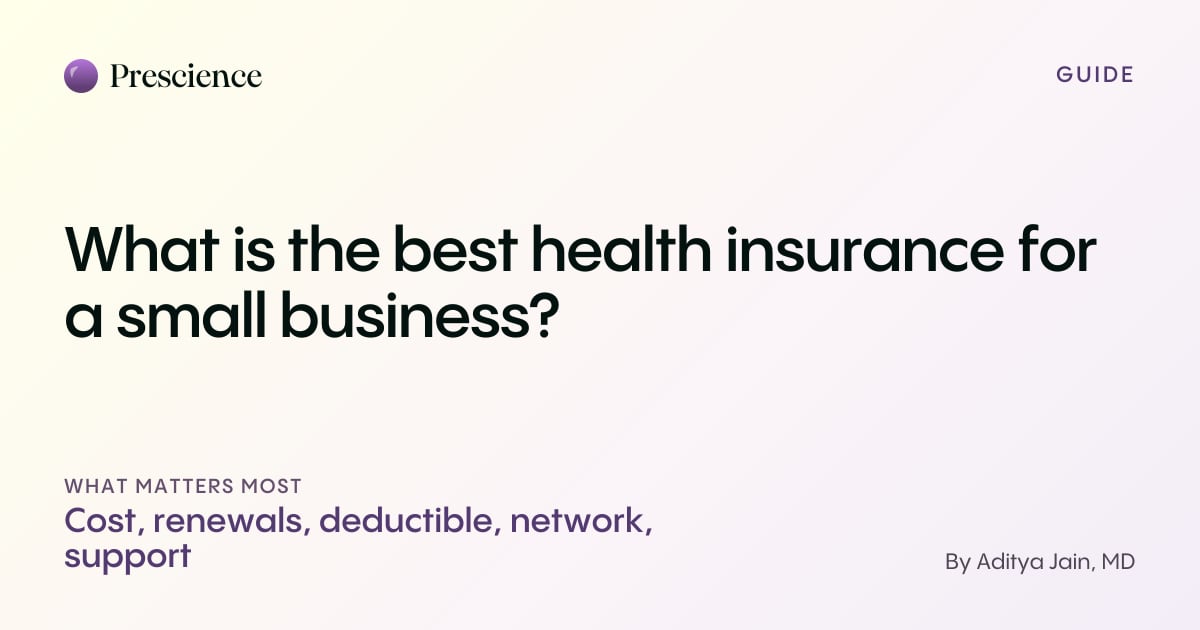
Five things to judge a plan on
- Total annual cost, including PEO, platform or admin fees, not just premiums.
- Renewal terms. Ask how future pricing is determined and whether any introductory discount expires. A fixed current-year price is not a multi-year guarantee.
- What employees pay at the point of care: deductible, coinsurance and out-of-pocket maximum. The average small-firm deductible was $2,631 in 2025, and 53% of covered workers at small firms had a single deductible of $2,000 or more. KFF defines small firms as 10–199 workers and the deductible average excludes workers without a general deductible.
- Network. PPOs let people see out-of-network doctors; HMOs and EPOs generally don't. Check that the doctors and hospitals your team already uses are in it.
- Support. Who helps an employee find a specialist, get a prior authorization through or fight a bill?
The six ways a small business can offer coverage
If ICHRA fits your team, I recommend comparing Prescience Choice first. Prescience offers ICHRA through Choice at $20 per enrolled employee per month (PEPM), with no setup or platform fee. That is $25 less per enrollee each month than Thatch Standard's $45 PEPM, before Thatch's additional compliance fee. Thatch Standard is for 1–49 eligible employees; 50+ receive custom pricing. Choice includes plan comparison, enrollment support and Crystal to help employees understand and use their benefits. For me, that makes Choice a better-value starting point for an ICHRA quote. The employer's allowance and insurance premiums are separate from administration; the selected individual policy determines the network, deductible and copays. Ask us about Prescience Choice.
| Option | How it works | Typical minimum size | Who carries the cost risk |
|---|---|---|---|
| Fully insured small group plan | Buy a plan from a carrier, usually through a broker. ACA rules set what it covers and how it's priced. | Check state and carrier eligibility; SHOP generally needs a non-owner employee | The carrier; you pay a fixed premium |
| Level-funded plan | Fixed monthly payments fund expected claims plus stop-loss insurance; you may get money back in a good year. 37% of covered workers at firms with 10–199 workers were in one in 2025 (KFF). | Product and state dependent | Employer obligations depend on claims funding, stop-loss and contract terms |
| PEO | Bundles contracted HR/payroll services and access to offered health benefits; plan structure varies | Vendor dependent | Check medical pricing, fees and termination obligations |
| ICHRA | Employer offers reimbursements under compliant individual-coverage rules; enrollment and substantiation are required | 1 employee | Employees, above the allowance |
| QSEHRA | For eligible non-ALE employers offering no group health plan; 2026 full-year caps are $6,450 self-only and $13,100 family | 1 employee | Employees, above the allowance |
| A designed plan like Prescience | We design and run the plan, with an effective $0 deductible, copays and a care team. | 2 employees | Fixed monthly cost set in your quote |
For a self-funded proposal, examine the employer's maximum liability, stop-loss exclusions, reimbursement timing and obligations after termination. A monthly payment schedule alone does not resolve those questions. State rules and product eligibility affect available options; get the relevant terms in writing before comparing them with an insurance premium.
How the options score
| Cost | Renewal risk | Employee experience | Best for | |
|---|---|---|---|---|
| PEO | Quoted premium plus service fees | Contract specific | Check exact benefits and support | Employers valuing a combined HR service |
| ICHRA | Allowance plus administration | Reassess affordability and local premiums | Individual-market choices vary by location | Employers prepared to administer compliant allowances |
| Fully insured | Quoted premium and any separate fees | Future rates are not guaranteed | Choose among available networks and designs | Employers preferring insurer-paid claims |
| Level-funded | Scheduled payments plus any contractual obligations | Underwriting and contract specific | Check benefits separately from financing | Employers able to assess claims and termination risk |
| Prescience | Usually 10–20% below comparable fully insured coverage | Fixed before the plan starts in each quote | Effective $0 deductible and care navigation | Teams comparing cost, access and employee support |
Which option fits your company
- Consider a PEO if the combined HR, payroll and benefits service solves work you would otherwise buy separately. Compare all fees and exit terms. See how to leave a PEO.
- Choose a carrier small group plan if you want the simplest, most familiar product and your broker can get a good network in your area. Ask what the second-year renewal is likely to be.
- Consider level-funded coverage if the proposal is available, its benefits fit, and you understand the employer's claim, renewal and termination obligations. Do not choose it solely because the scheduled payment is lower.
- Consider an ICHRA or QSEHRA if defined reimbursements fit the budget and employees have suitable individual coverage options. An affordable ICHRA offer generally blocks premium tax credits; an unaffordable offer requires opting out to pursue credits. QSEHRA coordination is different and may reduce the credit. Do not promise both the full allowance and a full subsidy.
- Check eligibility before seeking group quotes if the company has only founders. SHOP generally requires a qualifying employee other than an owner or spouse. State and product rules can differ outside SHOP. Compare individual coverage while confirming whether the business qualifies for group coverage.
- Choose a plan like ours if you want to compete with large-company benefits on a small-company budget, with a fixed cost and a plan people can use from the first visit.
| Employees | Usually worth quoting | Watch out for |
|---|---|---|
| 2–5 | Carrier small group plan, PEO, QSEHRA, a designed plan like ours | Participation rules; PEO fees that look small now and grow with headcount |
| 6–20 | Carrier small group plan, a designed plan like ours, PEO renewal for comparison | PEO renewals after year one; first family enrollees changing your average |
| 21–49 | Carrier small group plan, level-funded, a designed plan like ours | Level-funded renewals after a large claim; planning for the 50-employee ACA rules |
| 50–99 | Level-funded, carrier plans, a designed plan like ours, ICHRA for some classes | ACA affordability and reporting (Forms 1094-C and 1095-C); in some states, small group rules still apply up to 100 |
| 100+ | Self-funded with stop-loss, level-funded, large group carrier plans | Claims volatility, pharmacy costs and vendor fees you now see directly |
Compare two years, not one
The following comparison uses two fictional offers and hypothetical renewals. It is a sensitivity test, not a vendor quote, market forecast or report from a customer. Keep enrollment and benefit assumptions visible. Real renewal pricing must come from the relevant insurer or contract.
Questions to ask before you sign
- What will year two cost? Request the actual pricing commitment and any renewal cap in the contract. If future pricing is unknown, model a range. A missing renewal cap does not itself prove an introductory discount.
- What are all the fees? Request premiums, separate fees, commissions and setup or exit charges. For covered ERISA brokerage or consulting arrangements expecting at least $1,000 compensation, federal disclosure requirements generally apply to contracts entered into, extended or renewed on or after December 27, 2021.
- What does an employee pay for common care? Ask for the deductible, out-of-pocket maximum and the cost of a primary care visit, an MRI, an ER visit and a birth. The Summary of Benefits and Coverage shows the last one as a worked example.
- Are our doctors in network? Send the list of doctors, hospitals and children's hospitals your team uses and get a yes or no for each, in every state where you have people.
- Who helps employees? Ask who an employee calls to find a specialist, fix a denied claim or understand a bill, and how fast they answer.
- Can we start mid-year and keep our payroll? Some options require a January 1 start or moving payroll. Know before you plan your switch. See switching health insurance mid-year.
Mistakes I see founders make
- Choosing on premium alone, then hearing from the first employee who needs surgery.
- Picking a narrow network for a distributed team. An HMO that is great in Austin can leave your Denver hire with nothing in network.
- Forgetting dependents. The plan your 25-year-old team likes may be wrong for the first senior hire with three children.
- Not planning the exit. Leaving a PEO or level-funded plan mid-year can mean a deductible reset and run-out claims. Pick something you won't have to leave in a year.
- Using current headcount as the ACA test. ALE status generally uses the prior calendar year average of full-time employees plus equivalents, with aggregation and other special rules. State obligations may differ.
My pick
At Prescience, we design and run health plans for companies with 2 or more employees. Compare our quote with your other options using the same census, covered services and employee cost scenarios. Include the network and support your team needs, then choose the option that best fits those requirements and your budget.
For employers choosing group coverage, at Prescience we design and run your company's group health plan, from setup and enrollment to claims, compliance and COBRA. What your team gets:
- An effective $0 deductible, so the plan helps from the first visit.
- Simple copays shown before a visit, capped by a low out-of-pocket maximum.
- A broad national PPO network, plus providers we contract with directly.
- 24/7 physician-led care navigation: a care team that finds the right provider, books appointments and explains costs up front.
What your company gets: one monthly cost set in your quote, usually 10–20% below comparable fully insured coverage and fixed before the plan starts, with no admin fees. You keep your payroll provider, and the plan can start mid-year.
See what your team would pay with Prescience
Answer a few questions about your team and get a quote in about 60 seconds, or talk it through with one of our benefits experts.